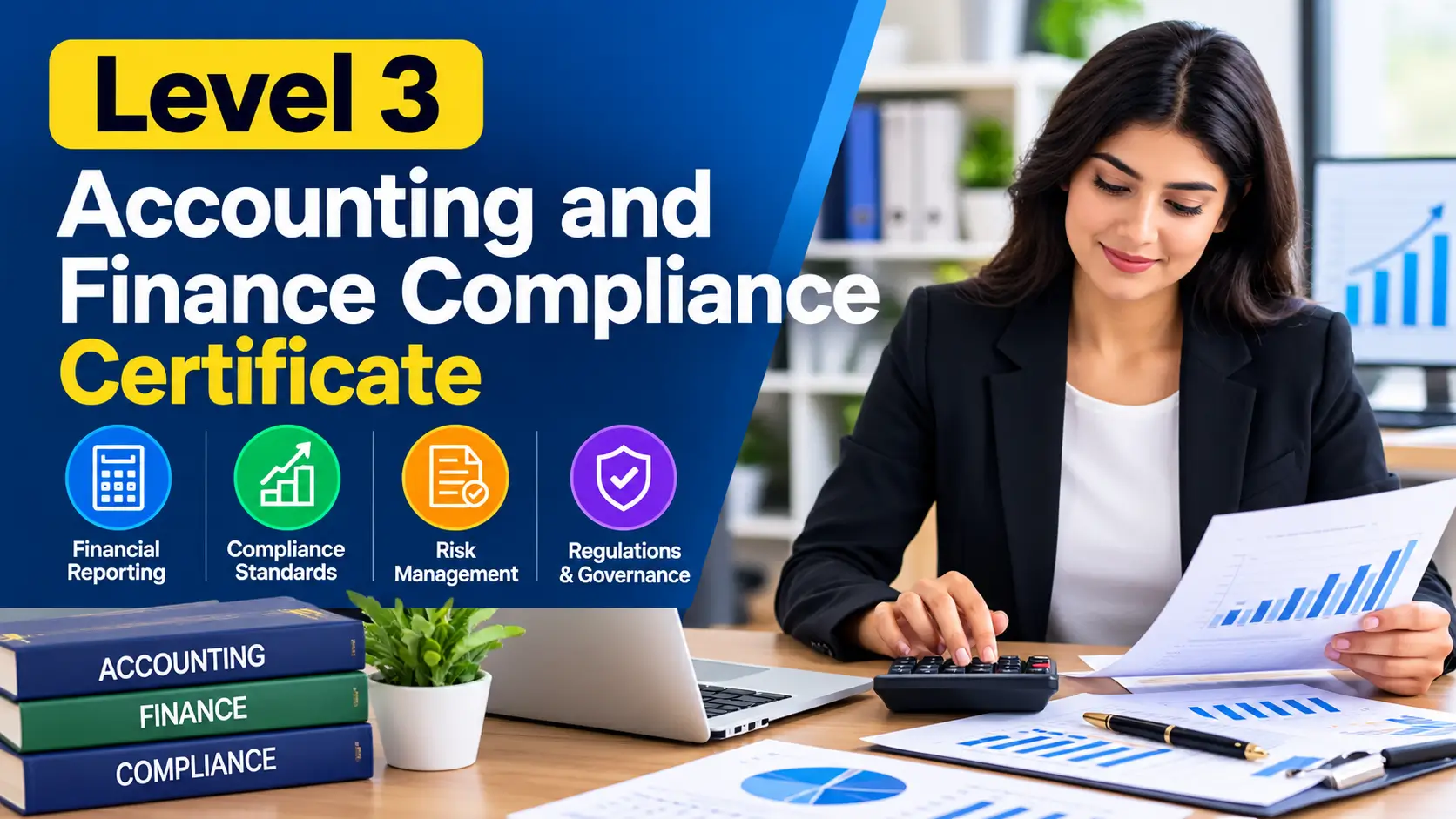
Level 3 Accounting and Finance Compliance Certificate
Level 3 Accounting and Finance Compliance Certificate Ready to Build a Career in Financial Compliance but Don’t Know Where to...
Official Certification
Recognized by top tech firms
Learn With Confidence





About This Course
Level 3 Accounting and Finance Compliance Certificate
Ready to Build a Career in Financial Compliance but Don’t Know Where to Start?
No finance experience? New to financial regulations and compliance procedures?
Gain essential financial compliance knowledge, understand regulatory responsibilities, and build a strong foundation for exciting career opportunities in the UK’s finance and accounting sector!
✅ Master Financial Compliance Fundamentals — Learn essential compliance principles, financial regulations, and the importance of ethical practices in finance and accounting.
✅ Understand Internal Controls & Risk Prevention — Explore how internal controls help organisations protect financial information, maintain accountability, and reduce compliance risks.
✅ Develop Financial Reporting & Whistleblowing Knowledge — Understand financial reporting requirements, accurate record keeping, ethical conduct, and workplace whistleblowing procedures.
✅ Explore Career Opportunities — Build industry-relevant knowledge to support roles in financial compliance, accounting support, finance administration, and compliance support across banks, accountancy practices, and regulated organisations.
COURSE OVERVIEW
Explore the principles of financial compliance, internal controls and responsible financial reporting with this Level 3 Accounting and Finance Compliance Certificate course. The programme introduces the role of compliance in supporting accurate financial processes and appropriate organisational oversight.
Throughout the course, you will examine internal controls, financial reporting responsibilities and the importance of compliance education within organisations. The curriculum also explores whistleblower programmes and reporting procedures, providing an understanding of how compliance concerns may be raised and addressed.
Designed for learners interested in accounting, finance and organisational compliance, this course provides foundational knowledge of the processes and responsibilities involved in maintaining financial accountability.
Key Curriculum Topics
-
Introduction to Financial Compliance: Explore the purpose and principles of compliance in financial activities.
-
Internal Controls: Understand how organisational controls support accurate and accountable financial processes.
-
Financial Reporting and Compliance: Examine the relationship between financial reporting and compliance responsibilities.
-
Compliance Training and Education: Explore how organisations communicate compliance expectations and responsibilities.
-
Whistleblower Programmes and Reporting: Understand the role of reporting channels and procedures for raising compliance concerns.
COURSE CURRICULUM
MODULE 1: INTRODUCTION TO FINANCIAL COMPLIANCE
This module introduces the fundamental concept of financial compliance and its importance within accounting and finance. It establishes the foundation for understanding how organisations approach compliance responsibilities.
Main learning topics:
- Introduction to financial compliance
- The role of compliance within accounting and finance
- Importance of financial compliance
- Organisational approaches to compliance
- Foundations of financial compliance practices
MODULE 2: INTERNAL CONTROLS AND FINANCIAL COMPLIANCE
This module examines the relationship between internal controls and financial compliance. Internal controls can help organisations protect assets, support reliable financial information and manage operational and compliance risks. The FCA describes internal controls as systems established to support orderly operations, safeguard assets and maintain accurate records.
Main learning topics:
- Internal controls
- Internal controls and financial compliance
- Financial control processes
- Supporting accurate financial information
- Compliance through effective controls
MODULE 3: FINANCIAL REPORTING AND COMPLIANCE
This module focuses on financial reporting in the context of compliance. Learners explore why accurate and reliable financial information is important and how reporting processes connect with wider compliance responsibilities.
Main learning topics:
- Financial reporting
- Financial reporting and compliance
- Accuracy of financial information
- Compliance considerations in reporting
- Relationship between accounting information and compliance
MODULE 4: COMPLIANCE TRAINING AND EDUCATION
This module examines the role of training and education in developing organisational awareness of compliance responsibilities. Effective compliance depends not only on policies and controls but also on people understanding their responsibilities.
Main learning topics:
- Compliance training
- Compliance education
- Employee awareness
- Communicating compliance responsibilities
- Supporting a compliance-focused workplace
MODULE 5: WHISTLEBLOWER PROGRAMMES AND REPORTING
This module introduces whistleblower programmes and reporting processes. Learners explore how organisations can establish channels for raising concerns and why effective reporting arrangements are important within financial and regulated environments. FCA rules require certain firms to maintain appropriate and effective arrangements for whistleblower disclosures, including appropriate handling, assessment and escalation of concerns.
Main learning topics:
- Whistleblower programmes
- Reporting concerns
- Whistleblower reporting processes
- Handling reported concerns
- Importance of effective reporting arrangements
WHO IS THIS COURSE FOR?
The Level 3 Accounting and Finance Compliance Certificate may be suitable for:
- Aspiring finance professionals
- Learners interested in financial compliance
- People exploring accounting and finance jobs
- Individuals seeking financial compliance training
- Accounting and finance support staff
- Finance administration professionals
- Employees involved in internal processes and controls
- People interested in compliance-related responsibilities
- Career changers moving towards accounting, finance or compliance
- Beginners who want to understand the relationship between accounting, finance and compliance
- Existing professionals who want to strengthen their knowledge of financial compliance principles
It may also be useful for learners researching the difference between accounting and finance and how compliance connects with both areas.
REQUIREMENTS
No formal entry requirements have been supplied for this programme.
Learners should review any employer-specific requirements if they intend to use their learning when applying for accounting, finance or compliance-related positions.
Completing this programme does not automatically provide professional registration, a regulated practising licence or eligibility for every accounting or finance role. Some positions may require additional qualifications, professional membership, work experience or employer-specific requirements.
SKILLS YOU CAN DEVELOP
Financial Compliance Knowledge — Develop an understanding of the fundamental principles of financial compliance.
Internal Control Awareness — Understand the role of internal controls in supporting financial and organisational compliance.
Financial Reporting Awareness — Develop knowledge of the relationship between financial reporting and compliance.
Accounting and Finance Understanding — Build knowledge of how accounting and finance activities connect with compliance responsibilities.
Compliance Education Awareness — Understand the importance of training and educating employees about compliance.
Whistleblower Programme Awareness — Develop an understanding of whistleblower programmes and their role in organisational reporting.
Reporting Awareness — Understand the importance of appropriate processes for raising and handling compliance concerns.
Financial Information Awareness — Recognise the importance of reliable and accurate financial information.
Organisational Compliance Awareness — Develop awareness of how compliance can be incorporated into organisational processes.
Risk and Control Awareness — Build an introductory understanding of how controls can support the management of financial and compliance-related risks.
LEARNING OUTCOMES
By completing the Level 3 Accounting and Finance Compliance Certificate, learners should be able to:
- Explain the fundamental concept of financial compliance.
- Describe the importance of financial compliance within accounting and finance.
- Explain the purpose of internal controls in financial compliance.
- Identify the relationship between internal controls and reliable financial information.
- Describe the role of financial reporting within compliance processes.
- Explain why accurate financial reporting is important to organisations.
- Describe the purpose of compliance training and education.
- Explain how employee awareness can support compliance responsibilities.
- Describe the purpose of whistleblower programmes.
- Explain the importance of appropriate reporting processes for compliance concerns.
CAREER PATHS
The curriculum can support knowledge development relevant to several accounting, finance and compliance-related environments. It should not be viewed as a guarantee of employment or as a replacement for professional qualifications where these are required.
ACCOUNTING TECHNICIAN
Typical UK Salary: £24,000–£35,000
How This Course May Be Relevant: Accounting technicians support financial operations, including financial records and accounting activities. The course’s focus on financial compliance, internal controls and reporting can provide useful supporting knowledge for this type of work. The National Careers Service lists a salary range of £24,000 to £35,000.
FINANCE OFFICER
Typical UK Salary: £26,000–£38,000
How This Course May Be Relevant: Finance officers manage organisational income and spending and maintain financial records for reporting and compliance purposes. The course directly relates to financial compliance, internal controls and reporting, making these areas particularly relevant.
AUDITOR
Typical UK Salary: £28,000–£70,000
How This Course May Be Relevant: Auditors examine financial records and procedures for accuracy, efficiency and compliance. Knowledge of internal controls and financial reporting can provide relevant foundational understanding for this career area. The National Careers Service lists an indicative salary range of £28,000 to £70,000.
PUBLIC FINANCE ACCOUNTANT
Typical UK Salary: £28,000–£60,000
How This Course May Be Relevant: Public finance accountants work to ensure money is managed appropriately within public-sector organisations. Financial compliance, controls and reporting are relevant areas of knowledge for this environment. The National Careers Service lists a salary range of £28,000 to £60,000.
COMPLIANCE-RELATED FINANCE SUPPORT ROLES
Typical UK Salary: Varies by role, employer, experience and location.
How This Course May Be Relevant: The programme covers financial compliance, internal controls, financial reporting, compliance education and whistleblower programmes. These subjects may be relevant to junior or support positions involving financial processes and organisational compliance.
Salary figures are indicative UK ranges and can vary considerably according to experience, location, employer and role. The National Careers Service provides salary and progression information for individual occupations.
FAQS
- WHAT IS FINANCIAL COMPLIANCE?
Financial compliance refers to the processes and practices organisations use to meet applicable financial, regulatory, legal and internal requirements. It is closely connected with accurate records, controls and reporting.
- WHAT IS THE LEVEL 3 ACCOUNTING AND FINANCE COMPLIANCE CERTIFICATE?
It is a focused programme covering financial compliance, internal controls, financial reporting, compliance training and whistleblower programmes.
- WHAT DOES FINANCIAL COMPLIANCE TRAINING COVER?
Financial compliance training can cover areas such as compliance principles, internal controls, financial reporting, employee education and reporting concerns.
- WHAT ARE FINANCIAL COMPLIANCE COURSES USEFUL FOR?
Financial compliance courses can help learners develop knowledge relevant to accounting, finance, compliance, internal controls and related business functions.
- WHAT IS THE DIFFERENCE BETWEEN ACCOUNTING AND FINANCE?
Accounting generally focuses on recording, organising and reporting financial information, while finance is broader and can involve financial planning, management, investment and decision-making. Compliance can be relevant to both.
- HOW DOES THIS PROGRAMME RELATE TO ACCOUNTING AND FINANCE JOBS?
The curriculum covers financial compliance, controls and reporting, which are relevant knowledge areas for several accounting and finance support roles.
- DOES THE PROGRAMME COVER INTERNAL CONTROLS?
Yes. Module 2 focuses specifically on Internal Controls and Financial Compliance.
- WHY ARE INTERNAL CONTROLS IMPORTANT?
Internal controls can help organisations safeguard assets, support reliable financial information, improve operational effectiveness and maintain compliance with policies and applicable requirements.
- DOES THE PROGRAMME COVER FINANCIAL REPORTING?
Yes. Module 3 focuses on Financial Reporting and Compliance and explores the relationship between reporting and compliance.
- WHAT IS A WHISTLEBLOWER PROGRAMME?
A whistleblower programme provides arrangements through which individuals can raise concerns about wrongdoing or other reportable matters. In regulated financial services, FCA rules include requirements around appropriate whistleblowing arrangements.
- DOES THIS PROGRAMME INCLUDE COMPLIANCE TRAINING?
Yes. Module 4 is dedicated to Compliance Training and Education and examines the importance of employee awareness and compliance education.
- CAN THIS HELP WITH FINANCIAL COMPLIANCE JOBS?
The programme can help develop foundational knowledge relevant to financial compliance responsibilities. Specific job requirements vary, and some positions require additional qualifications or experience.
- IS THIS PROGRAMME SUITABLE FOR BEGINNERS?
Yes. The curriculum begins with an introduction to financial compliance before progressing into controls, reporting, education and whistleblower programmes.
- DOES THE PROGRAMME COVER AUTOMATION IN ACCOUNTING AND FINANCE?
Automation in accounting and finance is an important modern industry topic, but it is not specifically listed as a module or learning topic in the supplied curriculum. This programme should therefore not be presented as specialist automation training.
- CAN THIS PROGRAMME QUALIFY ME AS AN ACCOUNTANT OR AUDITOR?
Not automatically. The programme provides focused knowledge in accounting and finance compliance, but regulated or professionally recognised roles may have additional qualification, membership, experience or employer requirements.
Course Content
Module 1_ Introduction to Financial Compliance
-
Introduction to Financial Compliance
Module 2_ Internal Controls and Financial Compliance
Module 3_ Financial Reporting and Compliance
Module 4_ Compliance Training and Education
Module 5_ Whistleblower Programs and Reporting
Frequently Asked Questions
There are many things that you might want to know. Well we have the answers.
