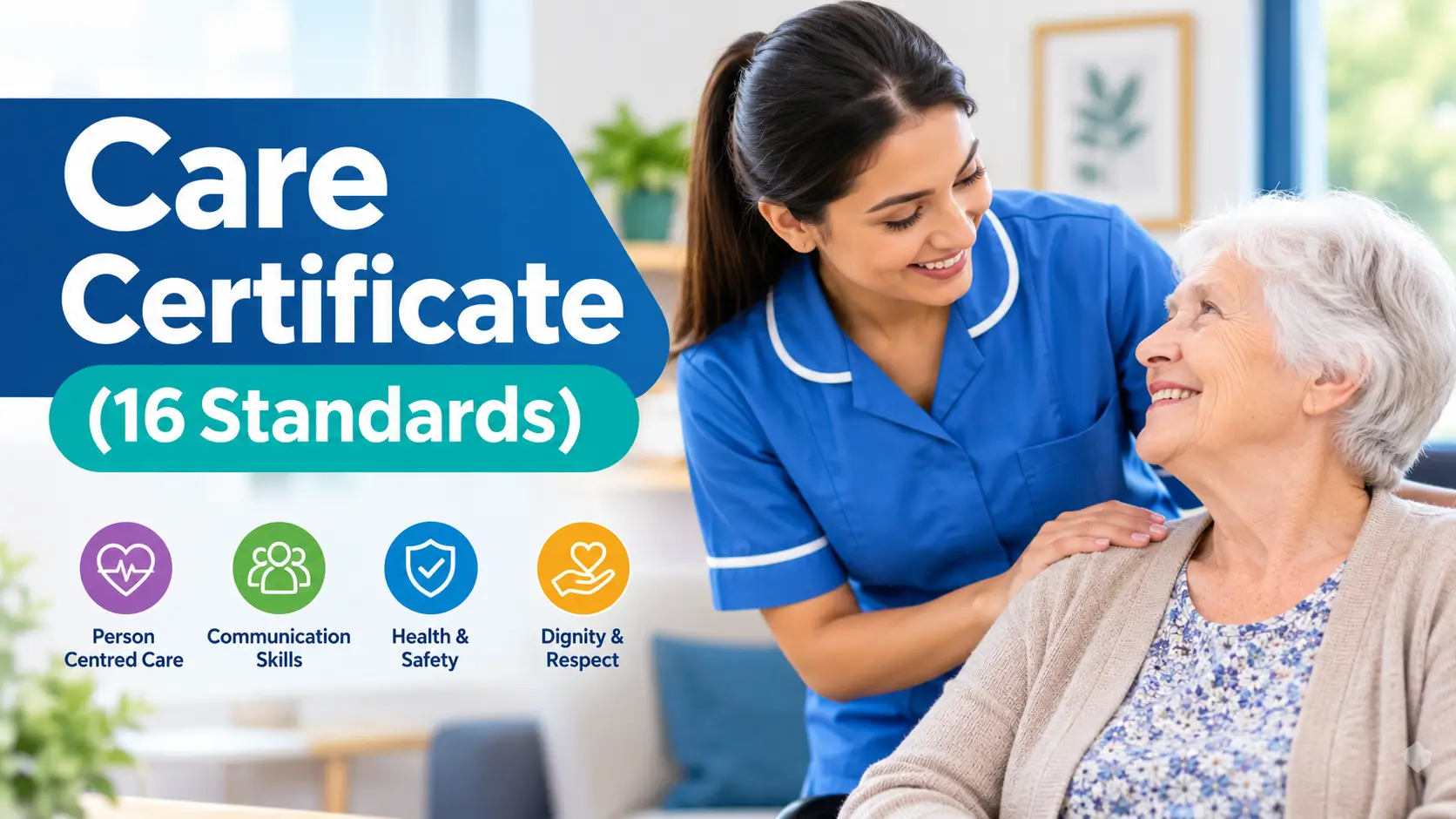
Care Certificate (16 Standards)
Care Certificate (16 Standards) The Care Certificate (16 Standards) course introduces essential principles and practices for people interested in health...
Official Certification
Recognized by top tech firms
Learn With Confidence



About This Course
Care Certificate (16 Standards)
The Care Certificate (16 Standards) course introduces essential principles and practices for people interested in health and social care. It covers professional responsibilities, personal development, safeguarding children and adults, person-centred care, infection prevention and control, and health and safety. You will also explore fluids and nutrition, equality and diversity, duty of care, confidentiality, communication, basic life support, mental health, privacy and dignity. These topics help learners understand the importance of safe, respectful and effective support. The course may suit aspiring care workers and healthcare support staff who want to develop foundational knowledge before pursuing further training or workplace experience.
What You Will Learn:
- Professional responsibilities and personal development in care.
- Safeguarding children and adults from harm.
- Person-centred care, equality, dignity and privacy.
- Infection prevention, health and safety, fluids and nutrition.
- Communication, confidentiality, basic life support and mental health awareness.
Course Overview
The Care Certificate (16 Standards) course introduces key principles relevant to health and social care support. Its curriculum explores professional responsibilities, personal development, safeguarding children and adults, person-centred care, infection prevention and control, and workplace health and safety. Learners also study fluids and nutrition, equality and diversity, duty of care, data protection, confidentiality and communication.
Further topics include basic life support, mental health awareness, privacy and dignity. Together, these subjects help learners understand how care workers can support individual wellbeing, respect people’s rights and follow safe working practices.
The course may be useful for people exploring care-related roles or preparing for additional workplace training. However, the Care Certificate is a specific UK workforce framework, and completing an online course alone does not automatically demonstrate that all required standards have been met. The traditional framework contains 15 standards, while newer guidance introduces an additional learning disability and autism awareness standard. Confirm the provider’s current curriculum, practical assessment arrangements and recognition details before enrolling.
Course Description
Build your understanding of care practices with the Care Certificate (16 Standards) course. This programme introduces important topics for people working towards roles in health and social care, including safeguarding, person-centred support, infection control, health and safety, communication and confidentiality. You will also explore professional responsibilities, personal development, nutrition, basic life support, mental health, privacy and dignity. The course provides an opportunity to develop foundational knowledge and understand expectations associated with safe and respectful care. Practical competence must be demonstrated through appropriate workplace learning, supervision and assessment where required by the relevant Care Certificate framework and employer.
Course Curriculum
Standard 1 – Your Role and Responsibilities
Understand the responsibilities of a care worker and the importance of working within agreed boundaries, policies and procedures.
Key learning topics:
- Roles and responsibilities in health and social care.
- Following workplace policies and procedures.
- Understanding professional boundaries.
- Accountability and raising concerns.
Standard 2 – Your Personal Development
Explore how ongoing learning, reflection and feedback can support professional development in care settings.
Key learning topics:
- Identifying learning and development needs.
- Setting professional development goals.
- Using feedback to improve practice.
- Maintaining knowledge and skills.
Standard 3 – Safeguarding Children
Develop an understanding of safeguarding children and recognising concerns that may indicate abuse, neglect or exploitation.
Key learning topics:
- Types and possible indicators of child abuse.
- Recognising safeguarding concerns.
- Reporting concerns through appropriate channels.
- Promoting children’s safety and wellbeing.
Standard 4 – Safeguarding Adults
Learn about safeguarding adults who may be at risk of abuse, neglect or exploitation and understand the importance of appropriate reporting.
Key learning topics:
- Types of abuse and neglect affecting adults.
- Recognising potential safeguarding indicators.
- Reporting and recording concerns.
- Promoting adults’ rights, safety and choice.
Standard 5 – Person-Centred Care
Explore how care can be tailored to each person’s needs, preferences, choices and individual circumstances.
Key learning topics:
- Understanding person-centred values.
- Promoting independence and choice.
- Involving individuals in care planning.
- Respecting personal preferences and goals.
Standard 6 – Infection Prevention and Control
Understand the principles used to reduce infection risks and maintain safe care environments.
Key learning topics:
- Hand hygiene and personal protective equipment.
- Cleaning and maintaining a safe environment.
- Safe handling and disposal of waste.
- Following infection prevention procedures.
Standard 7 – Health and Safety
Learn how to identify hazards and follow procedures that help protect people receiving care, colleagues and visitors.
Key learning topics:
- Identifying hazards and assessing risks.
- Fire safety and emergency procedures.
- Safe moving and handling principles.
- Reporting accidents and unsafe conditions.
Standard 8 – Fluids and Nutrition
Explore why hydration and balanced nutrition are important for health, comfort and wellbeing.
Key learning topics:
- Recognising the importance of fluids and nutrition.
- Understanding individual dietary requirements.
- Identifying possible signs of dehydration or malnutrition.
- Supporting safe eating and drinking according to care plans.
Standard 9 – Equality and Diversity
Understand how equality, diversity and inclusion contribute to fair, respectful and person-centred care.
Key learning topics:
- Understanding equality and diversity.
- Recognising discrimination and unfair treatment.
- Respecting cultural and individual differences.
- Promoting inclusive care practices.
Standard 10 – Duty of Care
Learn about the responsibility to provide appropriate support, follow professional standards and act when safety concerns arise.
Key learning topics:
- Understanding duty of care.
- Balancing safety with individual choice.
- Recognising and reporting unsafe practice.
- Managing concerns and disagreements professionally.
Standard 11 – Data Protection and Confidentiality
Explore how personal information should be collected, recorded, stored and shared appropriately in care environments.
Key learning topics:
- Protecting confidential information.
- Handling records securely.
- Understanding appropriate information sharing.
- Following data protection policies and procedures.
Standard 12 – Communication
Develop an understanding of effective communication and how to adapt approaches to individual needs.
Key learning topics:
- Verbal and non-verbal communication.
- Active listening and clear explanations.
- Recognising communication barriers.
- Maintaining accurate and respectful communication records.
Standard 13 – Basic Life Support
Gain an introduction to basic life support principles and the importance of responding appropriately to emergencies.
Key learning topics:
- Recognising a medical emergency.
- Raising the alarm and contacting emergency services.
- Understanding basic life support principles.
- Following recognised emergency procedures.
Important: An online learning module alone does not establish practical competence in CPR or other emergency procedures. Practical training and assessment may be required.
Standard 14 – Caring for Mental Health
Explore mental health awareness and the importance of compassionate support for people experiencing emotional or psychological difficulties.
Key learning topics:
- Understanding mental health and wellbeing.
- Recognising possible signs of distress.
- Communicating without judgement.
- Encouraging appropriate support and professional referral.
Standard 15 – Privacy and Dignity
Understand how to protect privacy, preserve dignity and respect individual choices during care activities.
Key learning topics:
- Respecting personal privacy.
- Supporting dignity during personal care.
- Obtaining consent and respecting preferences.
- Maintaining respectful professional boundaries.
Note about the 16-standard title: The modules supplied list 15 standards. The newer Care Certificate framework includes an additional standard on Learning Disability and Autism. Confirm with the provider whether this additional standard is included in the course before enrolling.
Who Is This Course For?
The Care Certificate (16 Standards) course may be suitable for:
- Aspiring care workers: People interested in entering health and social care.
- Healthcare support workers: Individuals who want to strengthen their understanding of care principles.
- Care assistants: People seeking foundational knowledge to support workplace learning.
- Residential care staff: Individuals interested in safe, respectful support.
- Home care workers: People exploring the principles involved in supporting individuals at home.
- Career changers: Learners considering a move into a care-related role.
- Further-study learners: People preparing to explore additional care training.
The course does not automatically satisfy all employer requirements or replace practical workplace assessment where required.
Requirements
No specific entry requirements are confirmed here. Check the provider’s current enrolment information before registering.
Learners may benefit from:
- An interest in health and social care.
- Basic reading, writing and communication skills.
- Access to a computer, tablet or smartphone.
- An internet connection for online learning.
- A willingness to follow safety and safeguarding procedures.
- Respect for confidentiality, dignity and individual differences.
Care roles may also require workplace induction, practical skills assessment, background checks and other employer-specific training.
Skills You Can Develop
By studying the course material, you may develop knowledge and understanding of:
- Professional roles and responsibilities.
- Personal development and reflective learning.
- Safeguarding children and adults.
- Person-centred care.
- Infection prevention and control.
- Workplace health and safety.
- Fluids, nutrition and hydration.
- Equality, diversity and inclusion.
- Duty of care and professional boundaries.
- Data protection and confidentiality.
- Communication and record keeping.
- Basic life support principles.
- Mental health awareness.
- Privacy and dignity.
These are potential learning outcomes. Practical competence must be demonstrated through the appropriate training and assessment required for the role and framework.
Learning Outcomes
After studying the course material, learners should be able to:
- Explain the responsibilities and professional boundaries of a care worker.
- Describe how personal development supports effective care practice.
- Recognise potential safeguarding concerns involving children and adults.
- Explain the principles of person-centred care.
- Identify practices that help prevent and control infection.
- Describe basic health and safety responsibilities in care environments.
- Explain the importance of adequate fluids and nutrition.
- Describe ways to promote equality, diversity and inclusion.
- Explain duty of care, confidentiality and appropriate information sharing.
- Describe the importance of effective communication, basic life support awareness, mental health support, privacy and dignity.
Career Paths
This course may help learners explore opportunities in health and social care. Depending on qualifications, practical competence, experience and employer requirements, possible areas of interest include:
- Care assistant roles.
- Healthcare support worker positions.
- Residential care support.
- Home care and domiciliary care.
- Community support services.
- Adult social care.
- Further training in health and social care.
- Additional workplace learning in safeguarding and patient support.
How to Get a Care Certificate with the NHS
The Care Certificate is a workforce development framework used in relevant health and social care settings in England. To work towards it, learners generally need to complete the required learning and demonstrate the relevant knowledge and practical skills in their workplace, with appropriate assessment.
A standalone online course may provide learning support, but it does not automatically mean the learner has achieved the full Care Certificate. If you are applying for an NHS or care provider role, ask the employer how it delivers and assesses the standards.
NHS Care Certificate and Care Certificate Standards 2026
The traditional Care Certificate framework contains 15 standards. Updated guidance introduced an additional standard focused on learning disability and autism awareness, resulting in a 16-standard framework. This makes it important to check whether a course advertised as covering 16 standards actually includes the additional standard.
For the most accurate current requirements, confirm the framework used by the employer or training provider rather than relying solely on the course title or the year in its marketing.
Important: The Care Certificate is not, by itself, a regulated qualification or professional registration. Employers may require additional qualifications, supervised practice and role-specific competency assessments.
Frequently Asked Questions
1. What is the Care Certificate?
The Care Certificate is a framework of standards designed to support the knowledge, skills and behaviours expected of workers starting in relevant health and social care roles in England.
2. How many Care Certificate standards are there?
The traditional Care Certificate has 15 standards. Updated guidance adds a standard focused on learning disability and autism awareness, creating a 16-standard framework. Check that your course covers the version you need.
3. Does this course cover all 16 Care Certificate standards?
The curriculum supplied for this course lists 15 modules or standards. The additional learning disability and autism standard is not listed separately, so confirm with the provider whether it is included.
4. How do I get a Care Certificate through the NHS?
You generally work through the required learning and demonstrate the relevant knowledge, skills and behaviours in an appropriate workplace, with assessment by someone authorised by the employer. Ask your NHS employer or prospective employer about its process.
5. Can I complete the Care Certificate online?
You can study supporting learning materials online, depending on the provider. However, completing an online course alone may not demonstrate all the practical competencies required for the full Care Certificate framework.
6. Is the Care Certificate a regulated qualification?
The Care Certificate is a set of workforce standards rather than, by itself, a regulated qualification. It should not be confused with a separately regulated health and social care qualification.
7. What topics are included in the Care Certificate?
Topics include professional responsibilities, personal development, safeguarding, person-centred care, infection control, health and safety, nutrition, equality, duty of care, confidentiality, communication, basic life support, mental health, privacy and dignity. The updated 16-standard framework also includes learning disability and autism awareness.
8. What are the Care Certificate answers?
Answers depend on the specific learning activity or assessment. The best approach is to understand the principles behind each standard and use the course materials and workplace guidance to complete tasks accurately and honestly.
9. Is the Care Certificate suitable for beginners?
It is designed to support people starting in relevant health and social care roles. Beginners can use learning materials to develop foundational knowledge, while practical competence must be demonstrated as required.
10. Does the Care Certificate help me get a care job?
It can help you understand the standards expected in care work. Employment depends on the role, employer requirements, practical skills, experience and any additional checks or qualifications needed.
11. Does the Care Certificate include safeguarding?
Yes. The supplied curriculum includes separate standards on safeguarding children and safeguarding adults, covering the importance of recognising and reporting concerns.
12. Does the course include basic life support?
Yes. The curriculum lists basic life support as Standard 13. Practical training and assessment may be needed to demonstrate competence in emergency procedures.
13. What is the difference between the 15 and 16 Care Certificate standards?
The 16-standard framework includes an additional standard focused on learning disability and autism awareness alongside the traditional 15 standards. Check the provider’s curriculum to confirm which version is covered.
14. Will I receive a certificate after completing this course?
Certificate availability and the conditions for receiving one depend on the provider’s arrangements. A provider-issued course completion certificate is not necessarily the same as achieving the full Care Certificate through workplace assessment.
15. How can I enrol in the Care Certificate course?
Visit the provider’s course page and check the current curriculum, fees, study format, assessment arrangements and certificate details before enrolling.
Course Content
Standard 1 – Your role and responsibilities
-
Your role and responsibilities
00:00
Standard 2 – Your personal development
Standard 3 – Safeguarding children
Standard 4 – Safeguarding adults
Standard 5 – Person-centered care
Standard 6 – Infection prevention and control
Standard 7 – Health and safety
Standard 8 – Fluids and nutrition
Standard 9 – Equality and diversity
Standard 10 – Duty of care
Standard 11 – Data protection and confidentiality
Standard 12 – Communication
Standard 13 – Basic life support
Standard 14 – Caring for Mental Health
Standard 15 – Privacy and Dignity
Frequently Asked Questions
There are many things that you might want to know. Well we have the answers.
