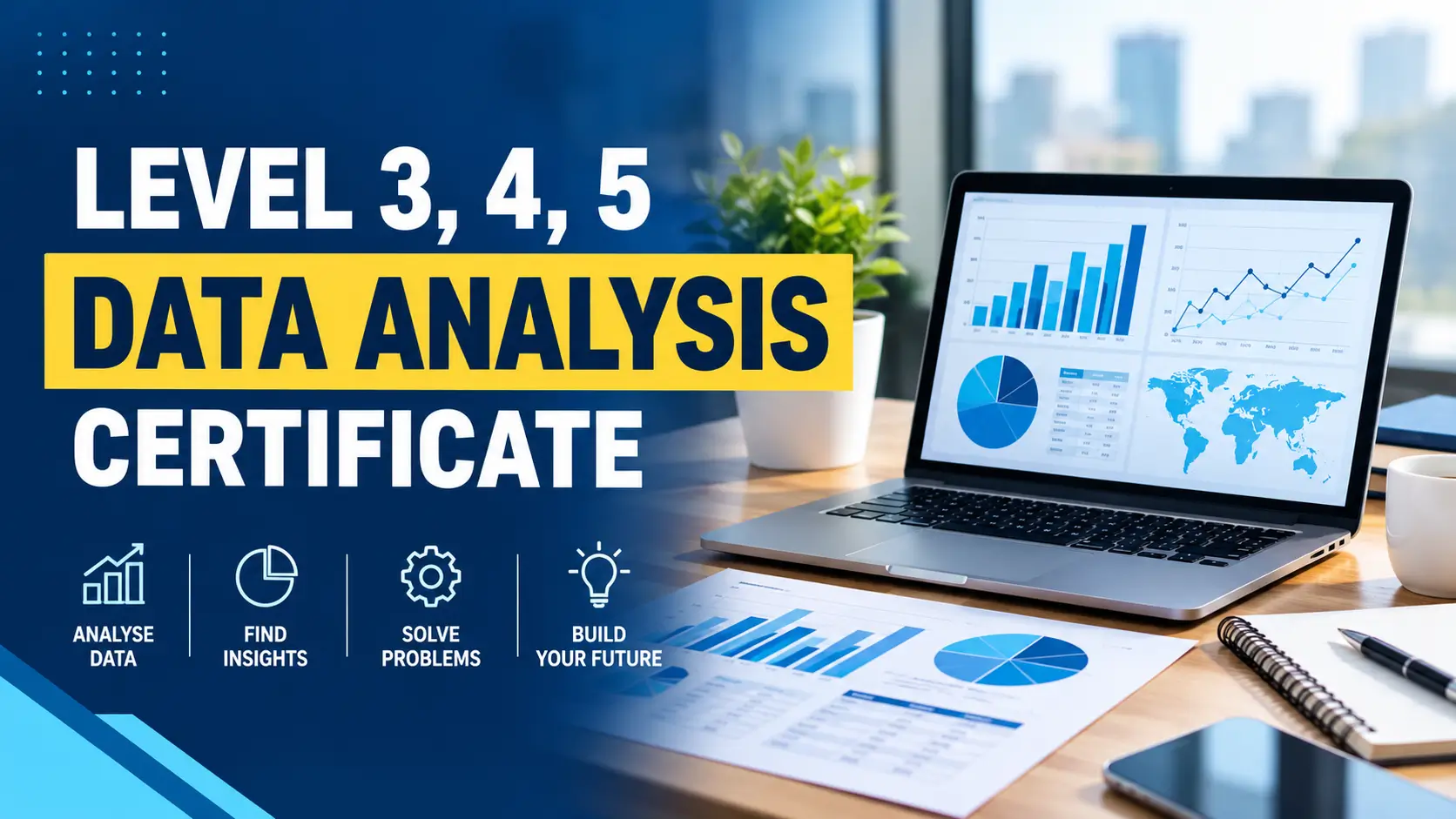
Level 3, 4, 5 Data Analysis Certificate
Level 3, 4, 5 Data Analysis Certificate The Level 3, 4, 5 Data Analysis Certificate provides structured learning across the...
Official Certification
Recognized by top tech firms
Learn With Confidence






About This Course
The Level 3, 4, 5 Data Analysis Certificate provides structured learning across the core areas of modern data analysis, from mathematical and statistical principles to data manipulation, visualisation, wrangling and exploration. The programme also introduces machine learning fundamentals and algorithms, followed by practical data analysis using Python and R libraries. It is relevant to learners exploring data analysis jobs, Python data analysis and Excel-based data analysis. Whether you are developing your first understanding of data or building knowledge of analytical tools and techniques, the curriculum provides a broad foundation for working with, interpreting and presenting data in modern professional environments.
Key curriculum areas include:
- Introduction to Data Analysis
- Mathematics and Statistics
- Data Manipulation and Data Wrangling
- Data Visualisation and Exploration
- Machine Learning, Python and R
COURSE OVERVIEW
Data analysis involves examining, organising and interpreting data to identify information, patterns and insights. The Level 3, 4, 5 Data Analysis Certificate covers the analytical process from foundational concepts through to programming-based data analysis and machine learning.
Learners begin with data analysis, mathematics and statistics, before progressing into data manipulation, visualisation, wrangling and exploration. The programme then introduces machine learning fundamentals and algorithms, providing an introduction to concepts that increasingly form part of modern data work. The final modules focus on data analysis with Python and libraries and data analysis with R and libraries.
This broad curriculum can be relevant to learners researching data analysis jobs, Python data analysis courses, exploratory data analysis, and analytical careers across different sectors. It provides knowledge spanning statistical concepts, data preparation, visual communication, programming and machine learning.
DESCRIPTION
The Level 3, 4, 5 Data Analysis Certificate explores the essential stages and technologies involved in modern data analysis. Learners study mathematics and statistics, data manipulation, data visualisation, data wrangling and data exploration, followed by machine learning fundamentals and algorithms.
The programme also introduces two widely used programming environments through dedicated modules on data analysis with Python and libraries and data analysis with R and libraries.
For learners researching data analysis training, Python data analysis and exploratory data analysis, this programme provides broad subject coverage across the analytical workflow, from understanding and preparing data to visualising information and applying programming-based analytical approaches.
COURSE CURRICULUM
MODULE 1: INTRODUCTION TO DATA ANALYSIS
This module introduces the fundamental principles of data analysis and establishes the foundation for the subjects covered throughout the programme.
Main learning topics:
- Introduction to data analysis
- Fundamental data analysis concepts
- Data analysis processes
- Working with data
- Foundations of analytical thinking
MODULE 2: MATHEMATICS AND STATISTICS
This module introduces mathematics and statistics as fundamental components of data analysis. Statistical knowledge can help analysts interpret data and understand patterns and relationships.
Main learning topics:
- Mathematical principles
- Statistical concepts
- Statistics for data analysis
- Interpreting quantitative information
- Mathematics in analytical work
MODULE 3: DATA MANIPULATION
This module focuses on data manipulation, introducing the processes involved in working with and modifying data for analytical purposes.
Main learning topics:
- Data manipulation
- Working with datasets
- Organising data
- Preparing data for analysis
- Manipulating data for analytical use
MODULE 4: DATA VISUALISATION
This module explores data visualisation, focusing on how data can be represented visually to make information easier to interpret and communicate.
Main learning topics:
- Data visualisation
- Visual representation of data
- Presenting analytical information
- Interpreting visual data
- Communicating data insights visually
MODULE 5: DATA WRANGLING
This module introduces data wrangling, an important part of preparing data for analysis. It focuses on working with data so that it can be used more effectively for analytical tasks.
Main learning topics:
- Data wrangling
- Preparing datasets
- Organising data
- Transforming data
- Preparing data for analysis
MODULE 6: DATA EXPLORATION
This module focuses on data exploration and introduces the analytical process of examining datasets to identify patterns, characteristics and potentially useful insights.
Main learning topics:
- Data exploration
- Exploring datasets
- Identifying patterns
- Examining data characteristics
- Exploratory data analysis
MODULE 7: MACHINE LEARNING FUNDAMENTALS
This module provides an introduction to the fundamental concepts of machine learning and its relationship with data analysis.
Main learning topics:
- Machine learning fundamentals
- Introduction to machine learning
- Machine learning concepts
- Relationship between data analysis and machine learning
- Foundations of machine learning
MODULE 8: MACHINE LEARNING ALGORITHMS
This module builds on the previous module by introducing machine learning algorithms and their role within analytical and machine learning workflows.
Main learning topics:
- Machine learning algorithms
- Algorithmic approaches
- Machine learning applications
- Analytical use of machine learning
- Relationship between algorithms and data
MODULE 9: DATA ANALYSIS WITH PYTHON AND LIBRARIES
This module introduces data analysis with Python and libraries, providing learners with knowledge of Python-based approaches to working with and analysing data.
Main learning topics:
- Python for data analysis
- Data analysis with Python
- Python libraries
- Working with data using Python
- Python-based analytical workflows
MODULE 10: DATA ANALYSIS WITH R AND LIBRARIES
This module introduces data analysis with R and libraries, giving learners an additional programming environment for working with data.
Main learning topics:
- R for data analysis
- Data analysis with R
- R libraries
- Working with data using R
- R-based analytical workflows
WHO IS THIS COURSE FOR?
The Level 3, 4, 5 Data Analysis Certificate may be suitable for:
- Aspiring data analysts
- Beginners interested in data analysis
- Learners researching data analysis jobs
- Individuals interested in exploratory data analysis
- People looking for structured data analysis training
- Learners interested in Python data analysis
- Individuals exploring R for data analysis
- Professionals who work with datasets
- Business professionals who want to strengthen their data knowledge
- Career changers considering analytical roles
- Learners interested in machine learning fundamentals
- Individuals who want to understand data visualisation
- People interested in statistics and analytical methods
- Learners researching Python data analysis courses
- Individuals looking to develop broader technical data skills
The programme may also be relevant to people researching Excel data analysis courses, although Excel is not specifically included in the supplied curriculum.
REQUIREMENTS
No formal entry requirements have been supplied for this programme.
Learners should check individual employer requirements when applying for data analysis, technology or analytical positions.
Completion of this programme does not automatically provide professional registration or guarantee eligibility for every data-related role. Employers may require additional qualifications, practical experience, technical skills or knowledge of specific software.
SKILLS YOU CAN DEVELOP
Data Analysis Knowledge — Develop an understanding of fundamental data analysis principles and processes.
Mathematical and Statistical Awareness — Build knowledge of mathematics and statistics relevant to analytical work.
Data Manipulation — Develop knowledge of working with and modifying datasets for analysis.
Data Visualisation — Understand how data can be represented visually and communicated effectively.
Data Wrangling — Develop awareness of preparing, organising and transforming data for analytical use.
Data Exploration — Learn about exploring datasets and identifying patterns and characteristics.
Exploratory Data Analysis — Develop foundational knowledge of examining data to identify potentially useful patterns and insights.
Machine Learning Awareness — Build an understanding of fundamental machine learning concepts.
Machine Learning Algorithm Awareness — Develop knowledge of the role of algorithms in machine learning.
Python Data Analysis — Develop knowledge of using Python and libraries for data analysis.
R Data Analysis — Develop knowledge of using R and libraries for data analysis.
Analytical Thinking — Develop the ability to approach datasets systematically and consider information from an analytical perspective.
LEARNING OUTCOMES
By completing the Level 3, 4, 5 Data Analysis Certificate, learners should be able to:
- Explain fundamental concepts of data analysis.
- Describe the role of mathematics and statistics in data analysis.
- Explain the purpose of data manipulation.
- Describe how data visualisation can support the presentation of information.
- Explain the purpose of data wrangling when preparing datasets.
- Describe the principles of data exploration and exploratory data analysis.
- Explain fundamental concepts associated with machine learning.
- Describe the role of machine learning algorithms in analytical work.
- Explain how Python and libraries can be used for data analysis.
- Explain how R and libraries can be used for data analysis.
CAREER PATHS
The curriculum provides foundational knowledge relevant to several analytical and data-focused career environments. It does not guarantee employment or a particular salary. Actual requirements vary according to the employer, role, industry, experience and technical skills required.
DATA ANALYST
Typical UK Salary: £28,000–£65,000
How This Course May Be Relevant: Data analysts work with datasets to identify information and insights that can support organisational decisions. The programme covers statistics, data manipulation, data visualisation, data wrangling, data exploration, Python and R, providing relevant foundational knowledge for this career area.
DATA SCIENTIST
Typical UK Salary: Varies considerably by experience, employer and location.
How This Course May Be Relevant: Data science can involve statistics, programming, data exploration and machine learning. The programme introduces mathematics and statistics, exploratory data analysis, machine learning fundamentals, algorithms, Python and R, providing relevant introductory knowledge.
BUSINESS INTELLIGENCE ANALYST
Typical UK Salary: Varies by employer, experience and location.
How This Course May Be Relevant: Business intelligence work involves analysing and presenting data to support organisational understanding and decision-making. The course’s focus on data manipulation, visualisation, exploration, statistics and programming may provide relevant foundational knowledge.
MARKET RESEARCH ANALYST
Typical UK Salary: Varies by role, employer, experience and location.
How This Course May Be Relevant: Market research involves collecting, analysing and interpreting information. Knowledge of statistics, data analysis, data exploration and visualisation can be relevant to analytical responsibilities in this field.
JUNIOR DATA / ANALYTICS ROLES
Typical UK Salary: Varies according to role, employer, location and experience.
How This Course May Be Relevant: The programme covers a broad range of foundational analytical subjects, including data manipulation, data wrangling, visualisation, statistics, Python, R and machine learning. These areas may be relevant to junior and entry-level analytical positions, depending on individual employer requirements.
Salary figures for data-related roles can vary significantly depending on technical ability, programming knowledge, experience, location, industry and employer. A course alone does not determine salary.
FAQS
WHAT IS THE LEVEL 3, 4, 5 DATA ANALYSIS CERTIFICATE?
It is a structured programme covering data analysis, mathematics, statistics, data manipulation, visualisation, data wrangling, data exploration, machine learning, Python and R.
WHAT IS DATA ANALYSIS?
Data analysis is the process of examining, organising and interpreting data to identify useful information, patterns and insights.
WHAT IS EXPLORATORY DATA ANALYSIS?
Exploratory data analysis involves examining and exploring datasets to understand their characteristics, identify patterns and discover potentially useful insights before further analysis.
DOES THIS PROGRAMME COVER EXPLORATORY DATA ANALYSIS?
Yes. Module 6: Data Exploration specifically covers data exploration and provides the foundation for understanding exploratory data analysis.
DOES THE PROGRAMME TEACH PYTHON DATA ANALYSIS?
Yes. Module 9: Data Analysis with Python and Libraries focuses specifically on Python-based data analysis.
DOES IT INCLUDE R DATA ANALYSIS?
Yes. Module 10: Data Analysis with R and Libraries introduces data analysis using R and its libraries.
DOES THIS PROGRAMME INCLUDE MACHINE LEARNING?
Yes. The programme includes Machine Learning Fundamentals and Machine Learning Algorithms in Modules 7 and 8.
DOES IT INCLUDE DATA VISUALISATION?
Yes. Module 4 focuses specifically on Data Visualisation.
DOES IT COVER DATA WRANGLING?
Yes. Module 5 is dedicated to Data Wrangling.
IS THIS SUITABLE FOR BEGINNERS IN DATA ANALYSIS?
The programme begins with Introduction to Data Analysis and then progresses through mathematics, statistics, data preparation, visualisation, exploration, machine learning, Python and R, making it suitable as a broad introduction to the subject.
CAN THIS HELP WITH DATA ANALYSIS JOBS?
The programme can help develop foundational knowledge relevant to data analysis jobs, particularly in areas such as statistics, data preparation, visualisation, exploration and programming. Specific employers may require additional technical skills, experience or qualifications.
WHAT IS THE DATA ANALYSIS SALARY PER MONTH?
There is no single data analysis salary per month. Earnings vary according to role, experience, employer, location and technical skills. Annual salaries are normally used when comparing UK careers, and monthly income depends on the individual’s employment and pay arrangements.
WHAT IS PYTHON DATA ANALYSIS SALARY?
There is no separate fixed Python data analysis salary. Python is a technical skill used in many data-related roles, and salaries depend on the job title, experience, employer, industry and wider skill set.
DOES THIS INCLUDE AN EXCEL DATA ANALYSIS COURSE?
No. Excel is not specifically listed in the supplied curriculum. The programme instead focuses on data analysis concepts, statistics, visualisation, data wrangling, machine learning, Python and R.
WHAT CAREERS CAN DATA ANALYSIS TRAINING SUPPORT?
Depending on experience and employer requirements, relevant career areas can include data analyst, data science, business intelligence and market research. The programme itself does not guarantee employment or a particular salary.
Course Content
Module 1 Introduction to Data Analysis.
-
Introduction to Data Analysis.
00:00
Module 2 Mathematics and Statistics.
Module 3 Data Manipulation.
Module 4 Data Visualisation.
Module 5 Data Wrangling.
Module 6 Data Exploration.
Module 7 Machine Learning Fundamentals.
Module 8 Machine Learning Algorithms.
Module 9 Data Analysis with Python and Libraries.
Module 10 Data Analysis with R and Libraries.
Frequently Asked Questions
There are many things that you might want to know. Well we have the answers.
