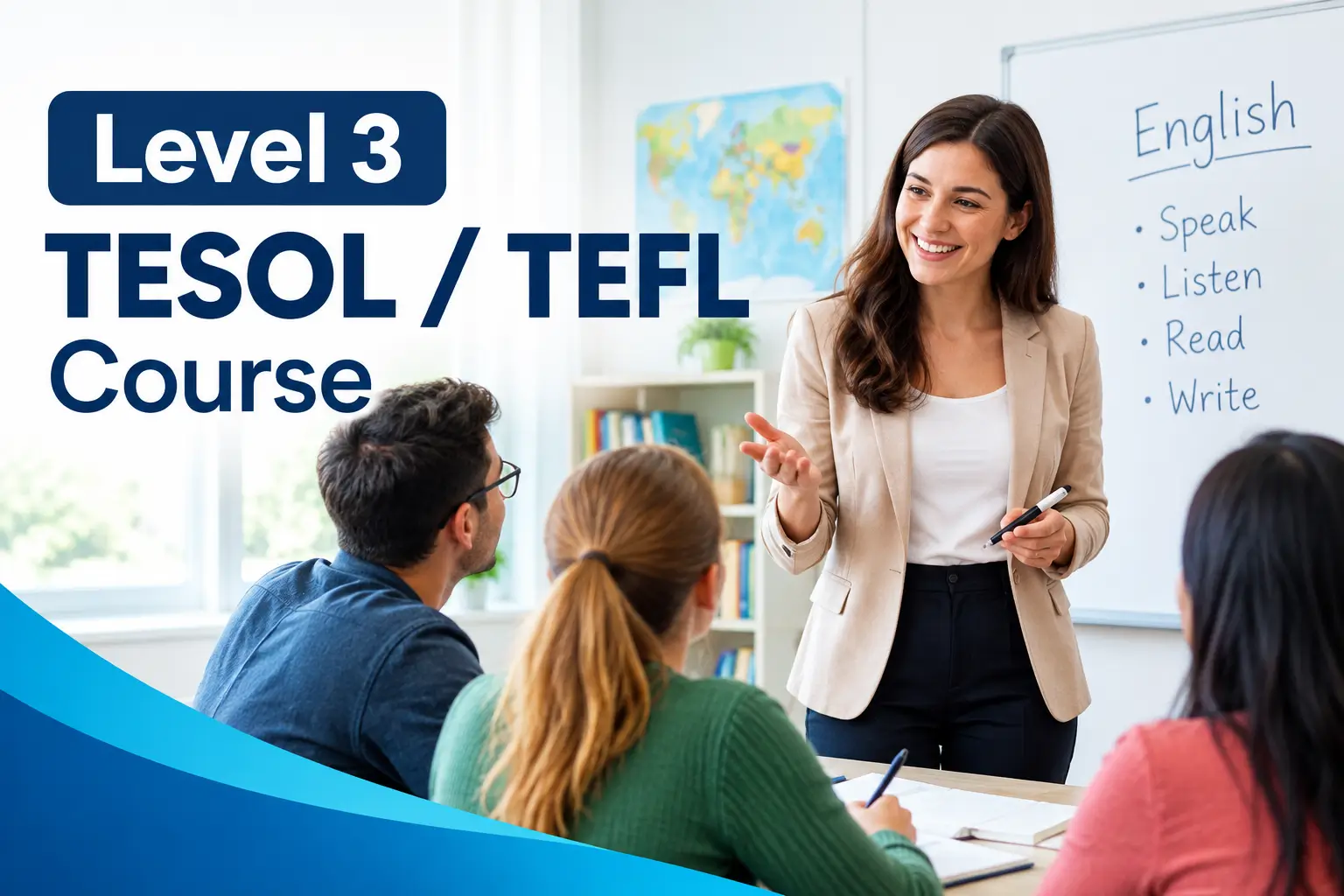
Level 3 TESOL / TEFL Course
Level 3 TESOL / TEFL Course Ready to Build a Career in English Language Teaching but Don’t Know Where...
Official Certification
Recognized by top tech firms
Learn With Confidence





About This Course
Level 3 TESOL / TEFL Course
Ready to Build a Career in English Language Teaching but Don’t Know Where to Start?
No teaching experience? New to TESOL or TEFL?
Develop essential English teaching skills, support learners in building language confidence, and take your first step toward exciting teaching opportunities in the UK and beyond!
✅ Master English Teaching Fundamentals — Learn essential TESOL and TEFL principles, language learning techniques, and effective teaching approaches.
✅ Develop Essential Language Teaching Skills — Explore how to teach speaking, reading, writing, and grammar while supporting learners’ English development.
✅ Build Confidence in Language Assessment — Understand how to assess learner progress, incorporate technology, and apply cultural awareness in teaching.
✅ Explore Career Opportunities — Build foundational knowledge for English teaching roles in schools, language centres, online education, and private tutoring.
COURSE OVERVIEW
Explore the principles of teaching English to speakers of other languages with this Level 3 TESOL / TEFL Course. The training introduces essential English language teaching concepts, including language learning, grammar, communication skills, and approaches to supporting learners from different cultural backgrounds.
Throughout the course, you will examine methods for developing speaking, reading, and writing skills, alongside language assessment and the use of technology in English language education. The curriculum also covers learning plans, practical teaching applications, cultural competence, and continuous professional development.
Designed for learners interested in TESOL and TEFL training, this course provides foundational knowledge of English language teaching and the principles involved in planning, supporting, and assessing language learning.
Key Curriculum Areas
-
English Language Learning: Explore fundamental principles of teaching and learning English.
-
Language Skills Development: Understand approaches to supporting speaking, reading, and writing.
-
Grammar and Cultural Competence: Examine grammar instruction and cultural awareness in language education.
-
Assessment and Technology: Explore language assessment methods and technology integration in teaching.
-
Learning Plans and Professional Development: Understand learning plans, practical teaching applications, and continuous professional growth.
COURSE CURRICULUM
MODULE 1 – THE BASICS OF ENGLISH LANGUAGE LEARNING
This module introduces fundamental concepts involved in learning English and provides a foundation for understanding language education.
Main learning topics:
- Fundamentals of English language learning
- English language development
- Learner needs
- Foundations of language education
MODULE 2 – SPEAKING PROFICIENCY, READING, AND WRITING
This module focuses on three core English language skills and considers how speaking, reading and writing contribute to language proficiency.
Main learning topics:
- Speaking proficiency
- Reading skills
- Writing skills
- Development of English language abilities
MODULE 3 – ADVANCED GRAMMAR AND CULTURAL COMPETENCE
This module explores advanced grammar alongside cultural competence, highlighting the importance of language knowledge and cultural understanding in English language learning.
Main learning topics:
- Advanced grammar
- Grammar development
- Cultural competence
- Language and cultural awareness
MODULE 4 – PRACTICAL APPLICATIONS AND LANGUAGE ASSESSMENT
This module focuses on applying language teaching knowledge in practical contexts and understanding language assessment.
Main learning topics:
- Practical language applications
- Language assessment
- Assessment principles
- Evaluating language development
MODULE 5 – TECHNOLOGY AND CULTURE INTEGRATION
This module explores the integration of technology and cultural considerations within English language learning and teaching.
Main learning topics:
- Educational technology
- Technology integration
- Cultural considerations
- Technology-supported language learning
MODULE 6 – LEARNING PLAN AND CONTINUOUS GROWTH
The final module focuses on developing learning plans and maintaining continuous growth within English language teaching and learning.
Main learning topics:
- Learning plans
- Goal setting
- Continuous learning
- Professional growth
WHO IS THIS COURSE FOR?
The Level 3 TESOL / TEFL Course may be suitable for:
- People interested in teaching English to speakers of other languages
- Learners exploring TESOL and TEFL
- Individuals researching what TESOL means
- People comparing TESOL vs TEFL
- Aspiring English language teachers
- Individuals interested in ESOL education
- People researching TESOL training
- Learners interested in language assessment
- Individuals wanting to understand technology in language teaching
- People considering further English language teaching development
It may also be relevant to people researching ESOL qualification providers, ESOL qualifications for training providers, or ESOL qualifications for education centres, although the specific suitability of any qualification or programme for a particular provider depends on that organisation’s requirements and the applicable regulatory framework.
REQUIREMENTS
No specific entry requirements have been provided for this programme.
Learners should check the course information before enrolment for any additional requirements that may apply.
SKILLS YOU CAN DEVELOP
Based on the supplied curriculum, learners can develop knowledge and skills in:
- Understanding English language learning principles
- Supporting speaking proficiency
- Understanding reading development
- Understanding writing development
- Applying advanced grammar knowledge
- Developing cultural competence
- Understanding language assessment
- Applying technology within language learning
- Integrating cultural considerations into teaching
- Developing structured learning plans
- Supporting continuous learning and professional growth
LEARNING OUTCOMES
By completing the curriculum, learners should be able to:
- Explain fundamental concepts associated with English language learning.
- Describe factors involved in developing English speaking proficiency.
- Explain approaches to supporting reading and writing development.
- Demonstrate understanding of advanced English grammar concepts.
- Explain the importance of cultural competence in language education.
- Describe practical applications of English language teaching knowledge.
- Explain the purpose and role of language assessment.
- Describe ways technology can be integrated into language learning.
- Recognise the importance of cultural integration within English language education.
- Develop learning plans that support continuous learning and growth.
CAREER PATHS
The Level 3 TESOL / TEFL Course develops knowledge relevant to English language teaching and learner support. Career requirements vary significantly according to country, employer, learner age group, teaching environment and the specific role. Completion of this training should not be presented as an automatic teaching licence, regulated qualification or guarantee of employment.
ENGLISH AS A FOREIGN LANGUAGE TEACHER
English as a foreign language teaching involves helping learners develop English communication skills in contexts where English may not be their first language.
Typical UK Salary: Salary varies according to employer, experience, location, teaching setting and qualifications. Specific EFL teaching roles may have different entry requirements.
How the course is relevant: The curriculum covers speaking, reading, writing, grammar, cultural competence, assessment and practical language applications, all of which relate to English language teaching.
ESOL TEACHER
ESOL teachers support learners who are developing English language skills. The role can involve teaching learners from different linguistic and cultural backgrounds.
Typical UK Salary: Pay varies according to employer, setting, experience and qualifications. Some ESOL teaching positions may require additional recognised teaching qualifications or experience.
How the course is relevant: The programme covers English language learning, language skills, cultural competence, assessment and learning-plan development.
ENGLISH LANGUAGE TUTOR
English language tutors may provide structured support to learners developing their English communication skills.
Typical UK Salary: Salary or hourly rates vary considerably depending on employment arrangements, experience, location and employer.
How the course is relevant: Speaking, reading, writing, grammar and practical applications within the curriculum can provide relevant subject knowledge for English language tutoring.
LANGUAGE TEACHING ASSISTANT
Language teaching assistant roles can involve supporting learners and teaching staff in educational settings, although specific requirements vary by institution.
Typical UK Salary: Pay depends on the employer, educational setting, location, experience and role requirements.
How the course is relevant: The curriculum develops knowledge of English language learning, learner skills, cultural competence, assessment and technology integration.
ENGLISH LANGUAGE EDUCATION SUPPORT
Some education and training environments involve supporting English language learners rather than independently leading a full teaching programme.
Typical UK Salary: Salary varies by role, employer, location, experience and required qualifications.
How the course is relevant: The course provides knowledge across language development, assessment, cultural competence and learning plans that can be relevant to learner-support environments.
TESOL AND TEFL EXPLAINED
WHAT DOES TESOL MEAN?
TESOL stands for Teaching English to Speakers of Other Languages. The term is commonly used to describe the field of teaching English to people whose first language is not English.
TESOL can encompass a broad range of English language teaching contexts, including teaching learners in English-speaking environments and other educational settings.
WHAT IS TEFL?
TEFL stands for Teaching English as a Foreign Language. It generally refers to teaching English in contexts where English is being learned as a foreign language.
The exact use of TESOL and TEFL can vary between organisations and regions, so learners should check how a particular institution defines and uses the terminology.
TESOL VS TEFL
TESOL and TEFL are closely related areas of English language teaching, but the terms can describe different teaching contexts.
TESOL means Teaching English to Speakers of Other Languages and is often used as a broader term.
TEFL means Teaching English as a Foreign Language and is generally associated with teaching English in countries or contexts where English is not the dominant language.
A programme using TESOL or TEFL in its title should therefore be assessed according to its actual curriculum, learning outcomes and stated recognition rather than the terminology alone.
TESOL CERTIFICATION AND ESOL QUALIFICATIONS
WHAT IS TESOL CERTIFICATION?
The term TESOL certification can refer to different types of teacher training credentials offered by different organisations. Recognition, entry requirements, teaching rights and professional value can vary considerably.
The supplied information identifies this programme as a Level 3 TESOL / TEFL Course, but does not provide details confirming a particular awarding body, regulated qualification status or external teaching licence. Those details should therefore not be assumed.
WHAT ARE ESOL QUALIFICATIONS?
ESOL refers to English for Speakers of Other Languages. ESOL qualifications and programmes can be designed for different purposes, including learner assessment, English language education and teacher development.
Anyone researching an ESOL qualification provider should check the awarding organisation, recognition, intended learner group, qualification level and progression opportunities before enrolling.
ESOL QUALIFICATIONS FOR TRAINING PROVIDERS
Training providers researching ESOL qualifications for training providers should consider whether a particular programme meets their own organisational, regulatory and awarding requirements.
The suitability of a programme for a training provider cannot be determined from the term ESOL alone.
ESOL QUALIFICATIONS FOR EDUCATION CENTRES
Education centres considering ESOL qualifications for education centres should similarly examine the specific recognition and requirements associated with the programme.
Factors may include the awarding organisation, intended purpose, curriculum, assessment arrangements and relevant regulatory requirements.
FREQUENTLY ASKED QUESTIONS
1. What is TESOL?
TESOL means Teaching English to Speakers of Other Languages. It refers broadly to the field of teaching English to people whose first language is not English.
2. What does TESOL mean?
TESOL stands for Teaching English to Speakers of Other Languages. It is a commonly used term within English language teaching.
3. What is TEFL?
TEFL means Teaching English as a Foreign Language. It generally describes teaching English in contexts where English is learned as a foreign language.
4. What is the difference between TESOL and TEFL?
TESOL is often used as a broader term for teaching English to speakers of other languages, while TEFL generally refers to teaching English as a foreign language. Terminology varies between organisations.
5. What does TESOL vs TEFL mean?
TESOL vs TEFL refers to the distinction between two closely related areas of English language teaching. The precise difference depends on how an organisation defines its programme and teaching context.
6. Does this programme provide TESOL certification?
The supplied information identifies the programme as a Level 3 TESOL / TEFL Course but does not provide specific details confirming a particular certification, awarding body or regulated status.
7. What does an ESOL qualification mean?
An ESOL qualification or programme relates to English for Speakers of Other Languages. Its purpose and recognition depend on the specific awarding organisation and programme.
8. What is an ESOL qualification provider?
An ESOL qualification provider is an organisation that delivers or awards an ESOL-related qualification or programme. Learners should check the provider’s recognition and the qualification’s intended purpose.
9. Are ESOL qualifications suitable for training providers?
Suitability depends on the training provider’s requirements, the programme’s recognition, curriculum, assessment arrangements and relevant regulatory framework.
10. Are ESOL qualifications suitable for education centres?
They can be relevant to education centres working with English language learners, but each centre should verify whether a particular qualification meets its own requirements.
11. What does this Level 3 TESOL / TEFL Course cover?
It covers English language learning, speaking, reading, writing, advanced grammar, cultural competence, language assessment, technology integration and continuous growth.
12. Can this course help me teach English?
The curriculum develops knowledge relevant to English language teaching. However, teaching requirements vary by employer, country and educational setting, and additional qualifications or experience may be required.
13. Does TESOL mean the same thing everywhere?
No. TESOL terminology can be used differently by organisations and in different countries. Learners should examine the actual curriculum and recognition of a specific programme.
14. Why is cultural competence important in TESOL?
English language learners can come from diverse linguistic and cultural backgrounds. Cultural competence can help teachers understand and respond appropriately to different learning contexts.
15. Is TESOL a good career area?
English language teaching offers various career pathways, but suitability depends on individual interests, qualifications, experience, location and employer requirements. This course provides foundational knowledge across several relevant teaching areas.
Course Content
Module 1_ The Basics of English Language Learning
-
The Basics of English Language Learning
00:00
Module 2_ Speaking Proficiency, Reading, and Writing
Module 3_ Advanced Grammar and Cultural Competence
Module 4_ Practical Applications and Language Assessment
Module 5_ Technology and Culture Integration
Module 6_ Learning Plan and Continuous Growth
Frequently Asked Questions
There are many things that you might want to know. Well we have the answers.
