Functional Skills Maths Level 2
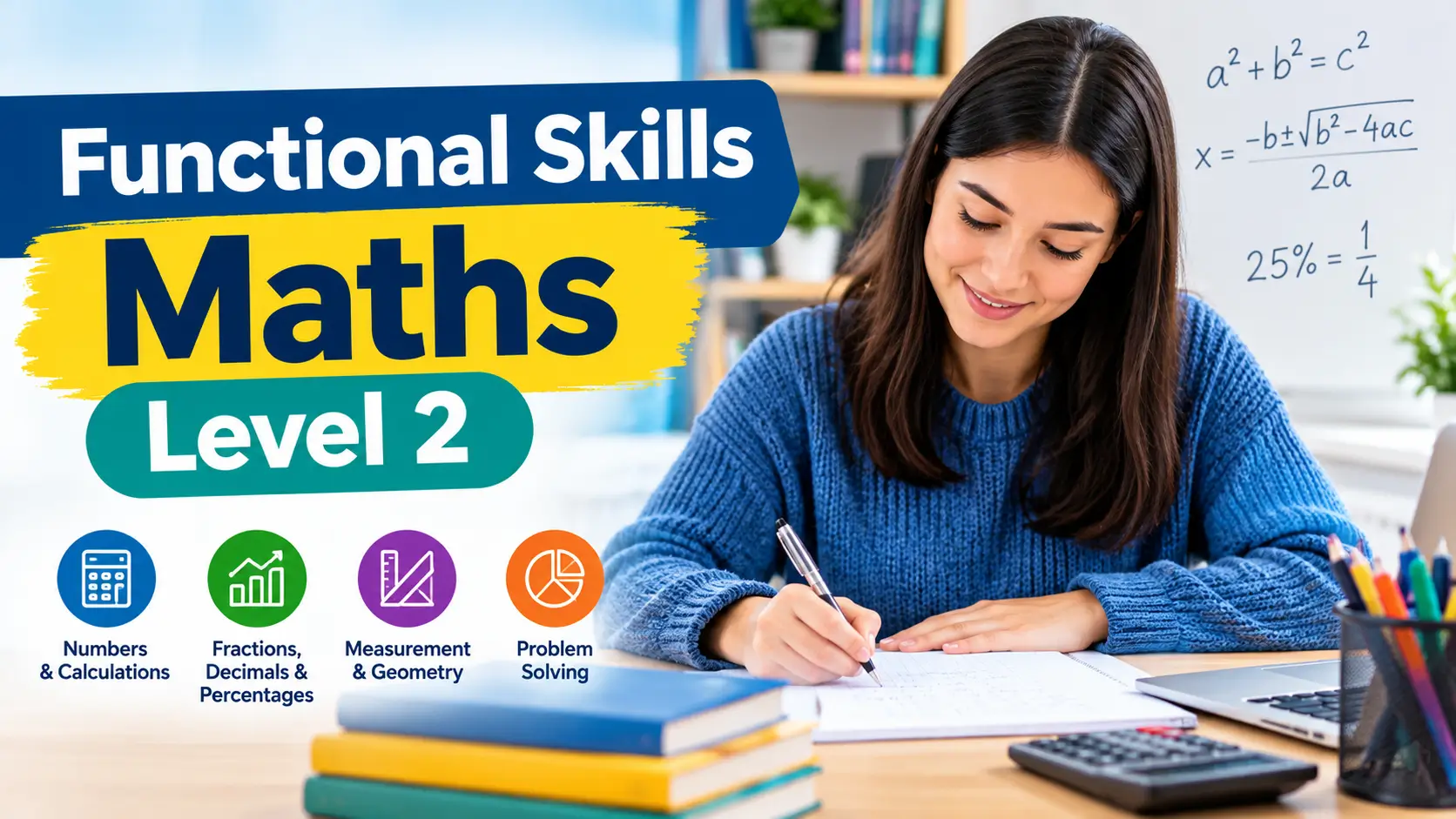
Functional Skills Maths Level 2 The Functional Skills Maths Level 2 course introduces mathematical concepts that can help learners develop...
Official Certification
Recognized by top tech firms
Learn With Confidence


About This Course
Functional Skills Maths Level 2
The Functional Skills Maths Level 2 course introduces mathematical concepts that can help learners develop confidence in everyday calculations, problem-solving and practical numeracy. The curriculum covers basic arithmetic, fractions, decimals, percentages, ratios, proportion, calculator use, powers, roots and units of measurement. These topics are useful for interpreting numerical information and applying maths to everyday situations, education and work. Whether you are preparing for further study or looking to strengthen your existing skills, this course provides an opportunity to revisit important mathematical principles. It may suit learners seeking flexible study before pursuing an appropriate Functional Skills Maths Level 2 qualification.
What You Will Learn:
- Apply basic arithmetic to everyday calculations.
- Work with fractions, decimals and percentages.
- Understand ratios, proportion and mathematical relationships.
- Use a calculator effectively to solve problems.
- Explore powers, roots, indices, units and engineering notation.
Course Overview
The Functional Skills Maths Level 2 course introduces essential mathematical concepts and techniques for practical problem-solving. Its curriculum begins with an introduction to functional mathematics before covering basic arithmetic, fractions, decimals and calculator use. Learners then explore percentages, ratio and proportion, powers, roots, laws of indices, units, prefixes and engineering notation.
These topics can help learners develop numerical confidence and understand how mathematics is applied in everyday situations, education and the workplace. The course may be useful for people preparing for further study, improving their numeracy or exploring a formal Functional Skills Maths qualification.
If your goal is to pass Functional Skills, check whether this course includes a recognised assessment or whether a separate examination must be arranged. Studying an online course does not automatically award a regulated Level 2 qualification. Confirm the provider’s assessment arrangements, certificate details and awarding organisation information before enrolling, especially if you need the qualification for employment, an apprenticeship or further education.
Course Description
Build your numeracy skills with the Functional Skills Maths Level 2 course. Explore essential topics such as arithmetic, fractions, decimals, percentages, ratios, proportion, calculator techniques, powers, roots and units of measurement. The curriculum introduces mathematical principles that can help you approach everyday calculations and numerical problems with greater confidence. It may suit learners who want to strengthen their maths knowledge or prepare for further education and training. If you need a formal Level 2 Functional Skills Maths qualification, check the course’s assessment arrangements and recognition status before enrolling, as additional examination or assessment requirements may apply.
Course Curriculum
Module 01 – Introduction
Explore the purpose of functional mathematics and how numerical skills can be applied to practical situations at home, in education and at work.
Key learning topics:
- Understanding functional mathematics and numeracy.
- Applying maths to everyday situations.
- Identifying numerical information in practical problems.
- Developing a structured approach to mathematical problem-solving.
Module 02 – Basic Arithmetic
Develop your understanding of the four basic arithmetic operations and how they are used to solve numerical problems accurately.
Key learning topics:
- Addition and subtraction.
- Multiplication and division.
- Understanding the order of operations.
- Solving everyday numerical problems.
Module 03 – Fractions
Learn how fractions represent parts of a whole and explore methods for calculating with different types of fractions.
Key learning topics:
- Understanding numerators and denominators.
- Simplifying fractions and finding equivalent fractions.
- Adding and subtracting fractions.
- Multiplying and dividing fractions.
Module 04 – Decimals
Understand decimal notation and develop confidence in comparing, calculating and converting decimal values.
Key learning topics:
- Understanding decimal place value.
- Ordering and comparing decimals.
- Performing calculations with decimals.
- Converting between fractions and decimals.
Module 05 – Using a Calculator
Explore how to use a calculator accurately and efficiently when working through mathematical calculations and practical problems.
Key learning topics:
- Understanding common calculator functions.
- Entering calculations in the correct order.
- Using brackets and memory functions where available.
- Checking answers through estimation and reasonableness.
Module 06 – Percentages
Learn how percentages express parts per hundred and how they are used in practical calculations involving prices, changes and proportions.
Key learning topics:
- Understanding percentages and equivalent fractions.
- Calculating percentages of amounts.
- Increasing and decreasing values by a percentage.
- Applying percentages to discounts, costs and everyday situations.
Module 07 – Ratio and Proportion
Explore how ratios compare quantities and how proportion can be used to solve problems involving related amounts.
Key learning topics:
- Understanding and simplifying ratios.
- Sharing quantities in a given ratio.
- Solving direct proportion problems.
- Applying ratios and proportion to practical situations.
Module 08 – Powers, Roots and Laws of Indices
Develop an understanding of powers, roots and index notation, including rules that simplify calculations involving exponents.
Key learning topics:
- Understanding powers and repeated multiplication.
- Calculating square roots and other common roots.
- Applying basic laws of indices.
- Simplifying expressions involving powers.
Module 09 – Units, Prefixes and Engineering Notation
Learn how units and prefixes represent measurements and explore how engineering notation can express very large or very small numbers.
Key learning topics:
- Understanding common units of measurement.
- Converting between related units.
- Using prefixes such as kilo, centi and milli.
- Expressing numerical values using engineering notation.
Who Is This Course For?
The Functional Skills Maths Level 2 course may be suitable for:
- Adult learners: People who want to improve their everyday numeracy.
- Students: Learners preparing for further education or additional training.
- Job seekers: Individuals who want to strengthen their maths knowledge for employment opportunities.
- Apprenticeship applicants: People preparing for pathways where a recognised maths qualification may be required.
- Career changers: Individuals looking to improve their confidence with numbers.
- Learners returning to education: People who want to revisit mathematical concepts after a break from studying.
- Functional Skills candidates: Learners preparing for a formal assessment who want additional study support.
If you need a qualification for a specific course, apprenticeship or job, check the exact qualification and assessment requirements before enrolling.
Requirements
No specific entry requirements have been confirmed for this course. Check the provider’s enrolment information for the latest details.
Learners may benefit from:
- Basic familiarity with numbers and simple calculations.
- An interest in improving mathematical skills.
- Access to a computer, tablet or smartphone.
- A reliable internet connection if the course is delivered online.
- A calculator for practising relevant calculations.
- A willingness to practise questions and review mistakes.
You do not necessarily need advanced mathematical knowledge to begin revising these topics. However, the Level 2 curriculum may involve multi-step calculations and applying mathematical concepts to unfamiliar problems.
Skills You Can Develop
By studying the course material, you may develop knowledge and understanding of:
- Basic arithmetic and numerical accuracy.
- Fraction calculations and simplification.
- Decimal operations and place value.
- Calculator use and checking answers.
- Percentage calculations and percentage changes.
- Ratios and proportional relationships.
- Powers, roots and index notation.
- Units of measurement and conversions.
- Mathematical problem-solving.
- Interpreting numerical information.
- Applying maths to practical situations.
- Building confidence for further maths study.
These are potential learning benefits. Your progress will depend on practice, understanding and the assessment requirements relevant to your goals.
Learning Outcomes
After studying the course material, learners should be able to:
- Explain the purpose of functional mathematics in everyday life, education and work.
- Perform basic arithmetic calculations using addition, subtraction, multiplication and division.
- Simplify fractions and perform common calculations involving fractions.
- Compare decimals and use them in mathematical calculations.
- Use a calculator to complete calculations and check whether answers are reasonable.
- Calculate percentages and apply percentage increases or decreases to practical problems.
- Simplify ratios and solve basic proportion problems.
- Explain powers, roots and the use of index notation.
- Apply basic laws of indices to suitable mathematical expressions.
- Recognise common units and prefixes, convert related measurements and interpret engineering notation.
Career Paths
Functional mathematics can support further education, workplace development and preparation for roles that involve handling numerical information. This course may help learners identify areas for further study, depending on their existing qualifications and experience.
Possible pathways to explore include:
- Further education and vocational training.
- Apprenticeships requiring suitable maths qualifications.
- Retail and customer service roles involving prices and transactions.
- Administration roles involving numerical records.
- Warehouse and logistics roles involving quantities and measurements.
- Construction training where appropriate maths knowledge is useful.
- Technical or engineering-related study.
- Further study towards a recognised Functional Skills Maths qualification.
Completing this course alone does not guarantee employment or establish that you hold a regulated Level 2 maths qualification. Employers and education providers may require a specific qualification, assessment result or certificate.
What Is Functional Skills Maths Level 2?
Functional Skills Maths Level 2 is a UK qualification level focused on applying mathematical skills to practical situations. It commonly covers areas such as number, calculations, fractions, percentages, ratio, measures and problem-solving. The exact assessment content depends on the awarding organisation’s specification.
How to Pass Functional Skills Maths Level 2
To improve your preparation, practise calculations regularly and focus on understanding the methods behind each answer. Review arithmetic, fractions, decimals, percentages, ratio and proportion, and make sure you can apply them to word problems. Practise using a calculator where permitted, show your working when useful and check your answers for accuracy.
If you need a formal qualification, use practice materials aligned with the relevant awarding organisation’s specification and confirm the examination format, permitted equipment and assessment requirements.
Frequently Asked Questions
1. What is Functional Skills Maths Level 2?
Functional Skills Maths Level 2 is a UK qualification level that assesses the ability to apply mathematical knowledge to practical problems. It covers numerical calculations and other maths skills relevant to everyday life, education and work.
2. Is this a formal Level 2 Functional Skills Maths qualification?
The course title alone does not confirm that it awards a regulated qualification. Check the provider’s details for the awarding organisation, qualification status and whether a formal assessment or examination is included.
3. Can I study Functional Skills Maths Level 2 online?
Online learning can provide a flexible way to study maths topics. Check the provider’s current course format and whether you must arrange a separate examination to obtain a recognised qualification.
4. How can I pass Functional Skills Maths Level 2?
Practise the main topics regularly, including arithmetic, fractions, decimals, percentages, ratios and proportion. Work through practical word problems, review mistakes and use practice assessments that match the specification of your intended awarding organisation.
5. What topics are included in this course?
The supplied curriculum includes an introduction, basic arithmetic, fractions, decimals, calculator use, percentages, ratio and proportion, powers, roots, laws of indices, units, prefixes and engineering notation.
6. What is the difference between Functional Skills Maths Level 1 and Level 2?
Both levels focus on applying maths to practical situations, but Level 2 generally involves more complex calculations and problem-solving. The appropriate level depends on your current ability and the requirements of your intended employer or education provider.
7. Is Functional Skills Maths Level 2 equivalent to GCSE Maths?
Functional Skills Maths Level 2 is a separate qualification from GCSE Maths. Whether it is accepted as an alternative depends on the employer, college, university or programme you are applying to. Always check the specific entry requirements.
8. Do I need a calculator for Functional Skills Maths Level 2?
Calculator use can be relevant to many maths problems, but permitted equipment depends on the assessment and awarding organisation. Learn to calculate accurately both with and without a calculator, and check the rules for your examination.
9. Is this course suitable for beginners?
The course may help learners revisit essential mathematical concepts, but Level 2 content can be challenging if you have little experience with maths. You may wish to revise basic number skills or consider Functional Skills Maths Level 1 before progressing.
10. What are the benefits of learning Functional Skills Maths Level 2?
Studying the subject can help you develop confidence in calculations, percentages, ratios, measurement and practical problem-solving. A recognised qualification may also meet entry requirements for some jobs, apprenticeships or further education programmes.
11. Can I use this course to prepare for a Functional Skills exam?
The curriculum may support revision and preparation. For the best results, check whether the materials align with your intended awarding organisation and practise using relevant sample questions and assessment-style problems.
12. How long does it take to complete Functional Skills Maths Level 2?
The time needed depends on your existing maths knowledge, study schedule and the provider’s course structure. Check the course page for any recommended study hours or completion guidance.
13. Will I receive a certificate after completing the course?
Certificate arrangements depend on the provider. A course completion certificate is not necessarily the same as a regulated Functional Skills Maths Level 2 qualification, which may require a separate approved assessment.
14. Can Functional Skills Maths Level 2 help me get a job?
A recognised qualification may meet maths requirements for some jobs or training opportunities. Employment also depends on the role, experience, other qualifications and the employer’s criteria. Check the specific requirements before relying on any course for career progression.
15. Where can I enrol in Functional Skills Maths Level 2?
Visit the provider’s course page and review the curriculum, fees, delivery format, assessment arrangements and certificate details. If you need a formal qualification, confirm that the course or its associated examination meets the requirements of your intended employer or education provider.
Course Content
Functional Skills Maths Level 2 Module 01 Introduction
-
Introduction
00:00
Functional Skills Maths Level 2 Module 2 Basic arithmetic
Functional Skills Maths Level 2 Module 3 Fractions
Functional Skills Maths Level 2 Module 4 Decimals
Functional Skills Maths Level 2 Module 5 Using a calculator
Functional Skills Maths Level 2 Module 6 Percentages
Functional Skills Maths Level 2 Module 7 Ratio and proportion
Functional Skills Maths Level 2 Module 8 Powers, roots and laws of indices
Functional Skills Maths Level 2 Module 9 Units, prefixes and engineering notation
Frequently Asked Questions
There are many things that you might want to know. Well we have the answers.
