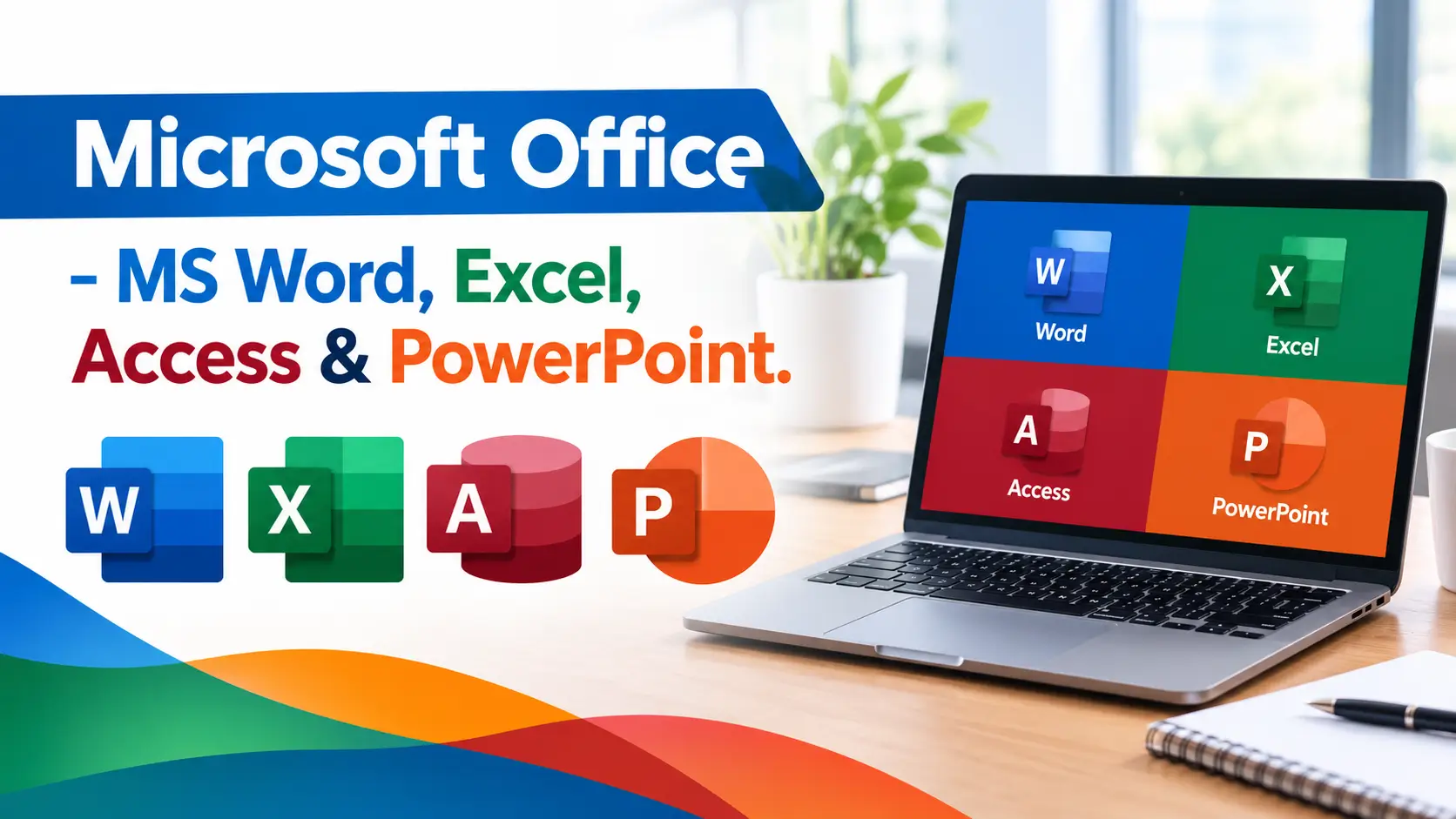
Microsoft Office – MS Word, Excel, Access & PowerPoint
Microsoft Office – MS Word, Excel, Access & PowerPoint The Microsoft Office – MS Word, Excel, Access & PowerPoint course...
Official Certification
Recognized by top tech firms
Learn With Confidence





About This Course
Microsoft Office – MS Word, Excel, Access & PowerPoint
The Microsoft Office – MS Word, Excel, Access & PowerPoint course introduces learners to four widely used applications for everyday office, academic and professional tasks. Explore how MS Word supports document creation, how MS Excel helps organise data and perform calculations, how MS Access manages databases, and how MS PowerPoint creates engaging presentations. Whether you want to improve your digital skills, prepare for administrative work or become more confident using office software, this course offers a starting point for developing practical knowledge. It is suitable for beginners and learners seeking to strengthen their understanding of Microsoft Office applications for workplace productivity.
What You Will Learn
- The essential features and uses of Microsoft Office applications.
- How to create, format and edit documents using MS Word.
- How to organise data, use formulas and work with spreadsheets in MS Excel.
- How to understand database tables, records, queries and forms in MS Access.
- How to create structured and visually engaging presentations in MS PowerPoint.
- How to organise information and improve everyday office productivity.
- How Word, Excel, Access and PowerPoint can support administrative and professional tasks.
Course Overview
The Microsoft Office – MS Word, Excel, Access & PowerPoint course introduces four applications used across many workplaces, educational settings and personal projects. Learners can explore document creation in Word, spreadsheet management in Excel, database organisation in Access and presentation design in PowerPoint. These applications support different tasks, from preparing letters and reports to analysing information, managing records and presenting ideas clearly.
This course is suitable for beginners, students, office workers and individuals who want to develop their digital confidence. It can also provide a foundation for learners interested in MS Word courses online, MS Excel training courses, MS Access courses and MS PowerPoint training.
By studying these applications together, learners can build a broader understanding of how office software supports productivity and information management. The skills developed may be useful in administrative, customer service, business support and other office-based roles. Course depth, assessment methods and software compatibility depend on the provider’s current arrangements and the version of Microsoft Office used.
Course Description
Build your digital confidence with the Microsoft Office – MS Word, Excel, Access & PowerPoint course. This programme introduces four applications that help users create documents, manage spreadsheets, organise database records and deliver presentations. Learn how these tools support communication, data handling and everyday office tasks across different professional settings. Whether you are exploring an MS Word course online, seeking MS Excel training or developing your understanding of MS Access and PowerPoint, this course can help establish a foundation for further learning. Check the provider’s current syllabus, software requirements, assessment arrangements and certificate details before enrolling.
Course Curriculum
Curriculum note: A detailed module list was not provided. The following sections are suggested learning areas based on the four applications named in the course title, rather than a verified list of the provider’s official modules.
MS Word: Document Creation and Formatting
Explore how Microsoft Word supports the creation of professional documents. Learn about text formatting, page layout, document organisation and features that help produce clear, consistent written materials.
Key Learning Topics:
- Understanding the Word interface, menus and document tools.
- Creating, editing and formatting text.
- Working with headings, lists, tables and page layouts.
- Saving, reviewing and preparing documents for sharing or printing.
MS Excel: Spreadsheets and Data Management
Discover how Microsoft Excel can be used to organise information, perform calculations and present data. This learning area introduces spreadsheet structure, formulas, common functions and basic data analysis concepts.
Key Learning Topics:
- Understanding workbooks, worksheets, rows, columns and cells.
- Entering, formatting and organising spreadsheet data.
- Using basic formulas and functions for calculations.
- Creating charts and sorting or filtering information.
MS Access: Database Fundamentals
Learn the basic purpose of Microsoft Access and how databases can help organise structured information. Explore database components and how tables, queries, forms and reports work together to manage records.
Key Learning Topics:
- Understanding databases, tables, records and fields.
- Creating and organising tables for structured information.
- Exploring queries to retrieve selected records.
- Understanding forms and reports for entering and presenting data.
MS PowerPoint: Presentation Design
Explore how Microsoft PowerPoint helps communicate ideas through slide-based presentations. Learn about slide layouts, text, visual elements and presentation structure to support clear and engaging communication.
Key Learning Topics:
- Creating presentations and selecting appropriate slide layouts.
- Adding and formatting text, images, shapes and other elements.
- Using themes, transitions and animations appropriately.
- Organising slides and preparing presentations for delivery or sharing.
Working Across Microsoft Office Applications
Understand how the four applications can support connected office tasks. This learning area focuses on choosing the appropriate application for different needs and organising information efficiently.
Key Learning Topics:
- Choosing the right Microsoft Office application for a task.
- Using Word to prepare reports and business documents.
- Using Excel to organise data for tables, calculations and charts.
- Understanding how information can be presented or shared across applications.
Who Is This Course For?
The Microsoft Office – MS Word, Excel, Access & PowerPoint course may be suitable for:
- Beginners: People who want to learn the basics of commonly used office applications.
- Students: Learners who need to prepare assignments, organise information and deliver presentations.
- Office administrators: Individuals who want to strengthen their document, spreadsheet and record-management skills.
- Business professionals: Employees seeking to improve everyday productivity and communication.
- Job seekers: People who want to develop digital skills commonly requested for office-based roles.
- Customer service staff: Workers who may use documents, spreadsheets and presentations in their daily responsibilities.
- Small business owners: Individuals interested in organising records, preparing reports and presenting business information.
- Career changers: People looking to build a foundation in general office software before pursuing further training.
- Existing Microsoft Office users: Learners who want to review familiar features and expand their knowledge of applications they use less often.
Requirements
No specific prerequisites have been confirmed for this course. Check the provider’s current entry requirements before enrolling.
Learners may benefit from:
- Basic computer and keyboard skills.
- An interest in developing digital and office productivity skills.
- Basic reading, writing and numeracy skills.
- Access to a computer or laptop suitable for running the relevant software.
- A compatible version of Microsoft Word, Excel, Access and PowerPoint, depending on the course activities.
- Reliable internet access if learning materials are delivered online.
- A willingness to practise using the applications and explore their features.
Software note: Microsoft Access availability depends on the Microsoft Office edition and operating system being used. Check that your device and software version support the applications required by the course.
Skills You Can Develop
Studying Microsoft Office may help you develop the following skills, depending on the course content and the amount of practice you complete.
- Document creation: Preparing and formatting letters, reports and other written materials in MS Word.
- Spreadsheet management: Organising information into structured worksheets using MS Excel.
- Formula awareness: Understanding how formulas and functions can support calculations.
- Data organisation: Structuring information and identifying useful ways to manage records.
- Database fundamentals: Understanding the role of tables, queries, forms and reports in MS Access.
- Presentation design: Creating organised slides and presenting information clearly in MS PowerPoint.
- Information management: Choosing appropriate tools for different types of office tasks.
- Digital communication: Preparing documents and presentations that communicate information effectively.
- Attention to detail: Reviewing formatting, data and content for consistency.
- Workplace productivity: Using office applications to support common administrative and business activities.
Practical proficiency will depend on the features covered, your previous experience and the time you spend practising.
Learning Outcomes
By the end of the course, learners should be able to:
- Identify the main purposes and features of Microsoft Word, Excel, Access and PowerPoint.
- Create, edit and format basic documents using MS Word.
- Organise written content using headings, lists, tables and page-layout features.
- Structure spreadsheet information using rows, columns, cells and worksheets in MS Excel.
- Explain how formulas and functions can be used to perform spreadsheet calculations.
- Describe how charts, sorting and filtering can help organise and present spreadsheet data.
- Explain the purpose of tables, records, fields and queries in MS Access.
- Describe how forms and reports support database information management.
- Create and organise presentation slides using MS PowerPoint features.
- Select suitable Microsoft Office applications for common document, spreadsheet, database and presentation tasks.
Career Paths
Microsoft Office skills can be useful across a wide range of sectors. This course may help learners build foundational digital knowledge relevant to office-based work, but completing it does not guarantee employment or establish advanced proficiency on its own.
Potential career areas to explore include:
- Administrative assistant: Prepare documents, organise information and support routine office activities.
- Office administrator: Help manage records, correspondence, reports and day-to-day office processes.
- Data entry clerk: Enter and maintain information accurately using suitable software.
- Customer service representative: Use documents, spreadsheets and presentations to support customer-related tasks.
- Receptionist: Assist with administrative records, correspondence and general office communication.
- Business support assistant: Help prepare reports, maintain information and support team activities.
- Sales administrator: Organise sales information, maintain records and prepare routine reports.
- Project support assistant: Help track information, prepare documentation and communicate project updates.
- Junior reporting assistant: Support basic spreadsheet-based reporting where the role’s requirements match the learner’s skills.
- General office support worker: Use common office applications to complete a variety of administrative tasks.
Career requirements vary by employer and role. Positions involving advanced Excel analysis, database administration, automation or specialist reporting may require additional training, practical experience and more advanced technical skills.
Frequently Asked Questions
1. What is the Microsoft Office – MS Word, Excel, Access & PowerPoint course?
It is a course focused on four Microsoft Office applications used for document creation, spreadsheet work, database management and presentations. It aims to help learners build foundational knowledge of common office software.
2. What is MS Word used for?
MS Word is a word-processing application used to create, edit and format documents such as letters, reports, assignments, forms and other written materials.
3. Is an MS Word course online suitable for beginners?
An online MS Word course may be suitable for beginners who want to learn document creation and formatting. Check the course syllabus to confirm the topics, level and software requirements.
4. What can I learn from MS Excel training courses?
MS Excel training courses commonly cover spreadsheets, data entry, cell formatting, formulas, functions, charts and data organisation. More advanced training may cover lookup functions, pivot tables, complex formulas and data analysis.
5. What is the difference between basic and advanced MS Excel training?
Basic training generally focuses on spreadsheet structure, formatting and simple calculations. MS Excel advanced training may cover more complex functions, data analysis tools, pivot tables and other features, depending on the syllabus.
6. What is MS Access used for?
MS Access is a database management application that helps users organise structured information. It supports features such as tables, queries, forms and reports for managing and presenting records.
7. Is an MS Access course useful for office work?
An MS Access course may be useful for learners whose work involves structured records or database-based information. Its relevance depends on the software used by the employer and the responsibilities of the role.
8. What can I learn from MS PowerPoint training?
MS PowerPoint training commonly introduces slide creation, layouts, themes, text formatting, images, charts and presentation delivery. The depth of coverage depends on the course content.
9. What is the difference between an MS PowerPoint course and an MS PowerPoint presentation course?
Both may cover presentation creation and design. Some courses focus on basic slide creation, while others may explore visual communication, advanced layouts, animations and presenting to an audience. Review the syllabus to understand the scope.
10. Do I need previous Microsoft Office experience?
Previous experience may be helpful but is not necessarily required for an introductory course. Check the provider’s stated entry requirements and whether the material is designed for beginners.
11. Do I need to install Microsoft Office to study this course?
That depends on the delivery method and course activities. Practical exercises generally benefit from access to compatible software, but some introductory learning materials may be studied without installing every application. Confirm the requirements with the provider.
12. Can Microsoft Office skills help me get a job?
Microsoft Office skills are relevant to many administrative and business support roles. Employment also depends on your wider skills, experience, qualifications and the requirements of individual employers.
13. Will this course teach advanced Excel?
The exact level of Excel instruction has not been confirmed because a detailed provider curriculum was not supplied. Check the course syllabus to establish whether it includes advanced functions, pivot tables, data analysis or other specialist topics.
14. Will I receive a certificate after completing the course?
Certificate arrangements should be confirmed with the course provider. Check whether a certificate is included, whether an assessment is required and what the certificate represents. Do not assume that completion provides a particular professional or accredited qualification.
15. How can I choose the right Microsoft Office course?
Consider your current skill level, learning goals, software access, course content, assessment arrangements and cost. If you mainly prepare documents, prioritise Word. For calculations and data, focus on Excel. For structured records, explore Access. For presenting ideas, consider PowerPoint.
Course Content
Module- 1
-
Introduction
00:00 -
Getting Started On Windows Macos And Linux
00:00 -
How To Ask Great Questions
00:00 -
Faqs
00:00
Module- 2
Module- 3
Module- 4
Module- 5
Module- 6
Module- 7
Module- 8
Module- 9
Module- 10
Module- 11
Module- 12
Module- 13
Module- 14
Module- 15
Module- 16
Module- 17
Module- 18
Module- 19
Module- 20
Module- 21
Module- 22
Module- 23
Module- 24
Module- 25
Module- 26
Module- 27
Module- 28
Module- 29
Module- 30
Module- 31
Module- 32
Module- 33
Module- 34
Frequently Asked Questions
There are many things that you might want to know. Well we have the answers.
