How to Develop a Business Leadership Strategy


A business can have an ambitious growth plan without having the leadership capability needed to deliver it. Expansion may require managers who can lead larger teams, introduce new technology, make more complex decisions and maintain standards while the organisation changes.
Learning how to develop a business leadership strategy means deciding what leadership the organisation will need, assessing what capability already exists and creating a deliberate plan to close the gap.
That makes leadership development more than a collection of management courses. Effective leadership planning should connect future business priorities with recruitment, succession, coaching, performance, management development and organisational culture.
Done well, the strategy helps create leaders capable of supporting long-term business success rather than waiting until a critical role becomes vacant or a management problem has already appeared.
What Is a Business Leadership Strategy and Why Is It Important?
A business leadership strategy is a structured plan for ensuring that an organisation has the leadership capability required to achieve its objectives.
It answers questions such as:
Who needs to lead the business over the next few years?
Which leadership capabilities will those people require?
Where are current strengths and weaknesses?
Which roles would create serious disruption if the current leader left?
How will future managers be identified and developed?
How will leadership performance be measured?
This is different from choosing a leadership style.
Terms such as transformational, democratic or coaching leadership describe approaches to leading people. A leadership strategy operates at organisational level. It considers the supply, quality and development of leadership across the business.
A good strategy should therefore connect leadership requirements with the organisation’s direction rather than beginning with a generic list of desirable traits.
Why Leadership Strategy Matters for Business Success
Strategy is delivered through people.
A company may decide to enter new markets, introduce AI, acquire another business or expand internationally. Each decision creates new leadership demands.
A manager who successfully supervises a team of six may not automatically be ready to manage several departments. A technically excellent specialist may need substantial development before becoming responsible for people’s performance.
Leadership capability therefore affects execution.
Good managers translate organisational priorities into understandable work. They allocate resources, make decisions, develop employees, manage performance and respond when circumstances change.
CIPD’s evidence review describes people managers as an important link between senior management and employees, with responsibilities extending from day-to-day operations to coaching, strategy implementation and change.
A deliberate strategy also reduces overdependence on individuals.
If one senior manager holds all the relationships, knowledge and decision-making authority required to operate a division, their departure creates avoidable risk.
Effective leadership planning prepares the business before that problem occurs.
Essential Elements of an Effective Leadership Strategy
A useful leadership strategy normally combines several connected elements.
The first is business direction. Leadership requirements should emerge from where the organisation intends to go.
The second is capability definition. The company needs a clear picture of what effective leadership looks like at different levels.
Third comes assessment. Current leaders should be evaluated against those capabilities rather than simply assumed to be effective because they hold senior titles.
The strategy should then address development, succession, recruitment and performance.
It also needs a cultural component. Managers cannot be expected to model openness, accountability or innovation if organisational systems consistently reward the opposite behaviour.
Finally, there must be measurement.
A leadership programme can achieve high attendance while producing little noticeable improvement in how managers lead.
The objective is changed capability and stronger organisational performance, not maximum course completion.
How to Develop a Business Leadership Strategy
The most practical approach to how to develop a business leadership strategy is to work backwards from future business requirements.
Begin with the organisational strategy.
Suppose a company plans to double its customer base, automate several processes and expand into two new regions over three years.
Leadership implications might include:
- more managers capable of leading larger teams;
- stronger commercial decision-making;
- change-management capability;
- improved data and AI literacy;
- additional regional leadership planning;
- stronger succession for operational roles.
Next, define which capabilities matter at each leadership level.
Assess current leaders against those requirements and identify gaps.
Then decide how each gap should be addressed.
Some people may need coaching. Others require formal learning or practical stretch assignments. Certain capabilities may need to be recruited externally because developing them internally would take too long.
Finally, create measures and review points.
A practical cycle looks like:
business strategy → leadership requirements → capability assessment → development and succession actions → performance measurement → review
Leadership strategy should remain dynamic because the organisation’s requirements will change.
How to Define Your Leadership Vision and Goals
A leadership planning vision describes how leadership should operate in the organisation when it is working well.
Avoid vague ambitions such as “we want world-class leaders”.
Instead, define observable characteristics.
A business might expect its managers to:
communicate priorities clearly;
make evidence-informed decisions;
develop capable successors;
give useful feedback;
manage resources responsibly;
address performance problems promptly;
encourage appropriate challenge;
lead change constructively;
and act consistently with organisational values.
These expectations can then become measurable development goals.
For example, if the organisation repeatedly struggles to fill management vacancies internally, one goal might be to increase the proportion of critical roles with credible internal succession options.
If employee feedback identifies poor line-management communication, another goal could focus on improving regular performance and development conversations.
leadership planning goals should ultimately connect back to operational or organisational needs rather than becoming isolated HR targets.
How to Assess Your Current Leadership Team
Before investing in development, establish the current position.
Assessment should draw from several sources rather than one annual performance rating.
Managers can be reviewed through:
- performance against agreed objectives;
- employee and stakeholder feedback;
- behavioural observation;
- 360-degree feedback;
- succession discussions;
- development conversations;
- relevant capability assessments.
Use evidence carefully.
A manager running the highest-performing team is not automatically the strongest leader. They may have inherited an experienced team or unusually favourable commercial conditions.
Likewise, one difficult quarter does not prove that someone lacks leadership planning capability.
Assess both outcomes and behaviour.
The CMI Professional Standard offers one useful external framework because it considers areas such as personal effectiveness, communication, developing people, managing performance, change, resources and ethical leadership at different career levels.
Businesses can also create their own framework based on their strategy.
The important point is consistency. If one director is assessed on results while another is judged mainly on personality, the exercise becomes difficult to trust.
How to Identify Leadership Gaps and Opportunities
Once capabilities have been assessed, compare what the organisation has with what it expects to need.
Some gaps will be individual.
A manager may need stronger delegation or commercial awareness.
Others will be organisational.
Perhaps the company has excellent operational managers but almost nobody with experience leading major change.
A simple capability matrix can help.
List critical leadership capabilities against key roles or leadership planning levels and rate the current strength, future importance and depth of succession available.
Look beyond obvious weaknesses.
A capability that is currently adequate may become a serious risk if future strategy increases its importance.
For example, AI governance may not have been a significant leadership planning requirement three years ago. An organisation introducing AI into customer service, recruitment or decision-making may now need leaders capable of understanding benefits, risks and responsible use.
Leadership opportunities should also be identified.
A company may already have employees showing management potential but providing them with no route to develop.
The gap may therefore be less about talent scarcity and more about insufficient opportunity.
How to Develop Future Business Leaders

Succession planning should not begin when somebody resigns.
Identify roles that are important enough to require continuity and determine what experience a future successor would need.
CIPD’s current succession guidance emphasises identifying business-critical positions and developing talent through relevant, tailored experience.
That practical experience matters.
Reading about budget responsibility is not the same as managing a budget. Learning about difficult conversations does not demonstrate that someone can conduct one appropriately.
Future leaders can develop through:
- responsibility for real projects;
- temporary leadership assignments;
- cross-functional work;
- mentoring;
- coaching;
- job shadowing;
- structured management training;
- exposure to senior decision-making.
Avoid treating succession as a promise of promotion.
A potential successor may be developing towards a future role without being guaranteed it. Circumstances and performance can change.
Organisations should also avoid selecting future leaders solely because they resemble current leaders.
A changing strategy may require different capabilities from those that produced past business success.
How to Build a Strong Leadership Culture
leadership planning culture develops from what managers repeatedly do and what the organisation rewards.
A company can write “accountability” in its values while allowing senior leaders to blame other departments whenever something goes wrong.
Employees will learn from the behaviour, not the poster.
CIPD’s current work usefully distinguishes broad organisational culture from organisational climate: the policies, practices and behaviours employees actually experience.
This makes culture easier to work with.
Instead of trying to “create an innovative culture”, define the conditions required.
Do managers invite employees to question existing processes?
Are sensible experiments allowed to fail?
Are ideas considered regardless of seniority?
Do leaders share relevant information?
Similarly, if the organisation wants ethical leadership planning, decision processes, incentives and performance expectations should support ethical behaviour rather than rewarding results regardless of how they were achieved.
Senior leaders have particular influence because employees notice contradictions between stated values and executive behaviour quickly.
How to Improve Leadership Communication
Leadership communication is not simply more communication.
Managers need to explain priorities, decisions and changes in ways different audiences can understand.
A useful communication discipline includes four questions:
What has been decided?
Why was it decided?
What does it mean for this team?
What happens next?
Managers also need to listen.
Employees often understand operational problems that senior executives cannot see from dashboards.
Communication therefore needs routes upwards as well as downwards.
Regular one-to-one meetings, team discussions, employee forums and appropriate feedback mechanisms can provide useful channels.
During significant change, avoid creating certainty where none exists.
Saying “we have not decided that yet, but we expect to know by Friday” is generally more credible than providing an answer that later changes.
leadership planning communication is ultimately about clarity and trust, not presenting every message positively.
How to Align Leadership With Business Goals
Leadership development should begin with organisational priorities.
If the strategy requires international expansion, leaders may need capability in cross-cultural management, remote coordination and unfamiliar markets.
If operational efficiency is the priority, managers may need stronger process improvement, data interpretation and change skills.
If the business intends to differentiate through customer experience, leadership expectations may need to emphasise service standards, employee empowerment and customer insight.
Translate strategic objectives into leadership planning requirements.
Then translate those requirements into development priorities.
Performance management reinforces the connection.
CIPD guidance recommends aligning team effort with organisational goals while ensuring people have the skills, resources and support needed to perform.
This prevents leadership planning development becoming disconnected from business reality.
A manager’s development plan should therefore answer not merely “what would I like to learn?” but also “what capability will the organisation need from me?”
Both questions matter.
How to Create a Leadership Development Plan
Once organisational gaps are known, individual development plans can become much more specific.
For each leader, identify:
Required capability: What does the role require now or next?
Current level: What evidence shows their present capability?
Development action: What experience, learning or support could close the gap?
Application: Where will the person practise the capability?
Evidence: How will progress be demonstrated?
Review point: When will the organisation assess improvement?
Suppose a newly appointed manager needs stronger delegation skills.
Sending them on a course may provide useful concepts, but the development plan should go further.
They might identify two responsibilities to delegate, agree clear outcomes with employees, receive feedback from their own manager and review progress after eight weeks.
That turns learning into behavioural practice.
Use different development methods for different needs.
Formal programmes are valuable where structured knowledge is required. Coaching can help leaders work through behavioural challenges. Mentoring provides access to experience, while stretch assignments develop capability through responsibility.
Strong management development uses an appropriate mix rather than assuming every gap requires another course.
How to Measure Leadership Strategy Effectiveness
leadership planning strategy should be evaluated at several levels.
The first level is participation: did people complete the planned development?
That is easy to measure but tells you relatively little.
Next, assess capability and behaviour.
Are managers communicating more clearly? Has delegation improved? Are performance conversations happening consistently? Is decision-making becoming faster or better supported by evidence?
Then examine organisational outcomes related to the original problem.
A compact scorecard might include:
| Area | Possible measure |
| Leadership capability | Assessment or 360-feedback improvement |
| Succession | Critical roles with credible succession coverage |
| Development | Internal progression into management roles |
| Retention | Turnover in important leadership positions |
| People management | Employee feedback on manager effectiveness |
| Performance | Delivery against relevant team objectives |
| Development transfer | Evidence that learning is applied at work |
Be careful with causation.
If revenue rises after a leadership planning programme, that does not prove the programme caused the increase. Markets, pricing and dozens of other factors may have contributed.
Use a combination of evidence and connect measures to the specific capability the intervention was designed to improve.
Also review unintended consequences.
A strategy focused heavily on speed and accountability, for instance, could become counterproductive if employees feel unable to raise legitimate risks.
Best Leadership Development Tools and Resources
Leadership development does not require one particular software product.
The most useful resources are those that support assessment, learning, application and review.
Professional capability frameworks
CMI’s Professional Standard can help organisations benchmark leadership planning expectations at different career stages and identify development priorities.
Internal frameworks can then add capabilities specific to the organisation.
360-degree feedback
Structured feedback from managers, peers, direct reports and sometimes customers can reveal differences between how leaders believe they behave and how others experience them.
Feedback requires careful interpretation. It should be used for development rather than becoming a popularity contest.
Coaching and mentoring
Coaching can support reflection, problem-solving and behavioural change.
Mentoring can expose developing leaders to experience and organisational context they have not yet accumulated themselves.
Learning platforms and structured programmes
Online or classroom learning can efficiently provide common knowledge across a management population.
Businesses should distinguish introductory short courses, provider certificates, regulated qualifications, apprenticeships and professional designations because they represent different levels of depth and assessment.
Succession and talent reviews
Regular discussions about critical roles, potential successors and required development can make succession an active process rather than an emergency spreadsheet updated once a year.
Performance and development conversations
Some of the most valuable leadership planning development occurs through ordinary management.
Clear objectives, regular feedback and thoughtful stretch assignments can develop capability continuously.
The tool should always serve the development objective rather than becoming the objective itself.
Benefits and Challenges of a Business Leadership Strategy
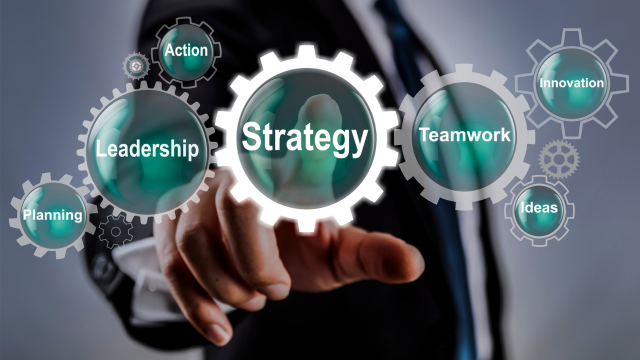
A coherent leadership strategy gives the organisation greater visibility over its management capability.
It can strengthen succession, reduce dependence on individual leaders and make development spending more targeted.
It can also help recruitment.
When a business knows which capabilities genuinely matter, job specifications and interviews can assess relevant leadership planning behaviour rather than relying on vague expectations of “charisma” or “executive presence”.
There are challenges.
Leadership capability is difficult to reduce to one number. Different roles require different strengths, and assessments can be affected by bias.
Development also takes time.
An organisation cannot normally create an experienced senior leader through a short programme alone.
There is a further risk of overengineering the system. Competency frameworks with dozens of behaviours can become so complicated that managers stop using them.
Keep the strategy rigorous but practical.
It should help leaders make decisions about capability, not create an additional bureaucracy that consumes more time than development itself.
Common Leadership Strategy Mistakes to Avoid
One common mistake is starting with training before diagnosing the problem.
If managers struggle because responsibilities are unclear or executive decisions constantly undermine them, another leadership workshop may achieve little.
Another mistake is focusing only on senior executives.
First-line and middle managers often have considerable influence over employees’ everyday experience and strategy implementation.
Businesses should also avoid:
- promoting technically strong employees without preparing them to manage people;
- confusing succession potential with guaranteed promotion;
- relying exclusively on self-assessment;
- developing leaders without giving them opportunities to practise;
- measuring course attendance rather than behavioural change;
- creating values that senior leaders do not follow;
- treating every manager as though they need identical development;
- ignoring business strategy when setting leadership priorities.
Another serious mistake is assuming strong historical performance guarantees future leadership effectiveness.
Businesses change.
The capabilities needed during a stable period may differ considerably from those needed during rapid expansion, restructuring or technological transformation.
Effective leadership planning is forward-looking.
Future Trends in Business Leadership and Management
AI is becoming a leadership issue rather than merely a technical one.
Skills England’s 2026 annual report identifies AI adoption as a significant workforce challenge and specifically highlights the need to develop AI expertise in leadership and management.
Managers increasingly need to understand where AI can improve work, where human judgement remains essential and which risks require governance.
They do not all need to become technical specialists.
They do need enough digital and AI literacy to ask sensible questions.
If an AI system recommends rejecting a customer, applicant or transaction, a responsible leader needs to understand whether that recommendation is reliable, explainable and appropriate.
Change capability will also become increasingly important.
AI, automation, hybrid work and shifting skill requirements mean many organisations are dealing with several changes simultaneously.
Future leaders therefore need to communicate uncertainty, prioritise competing transformation initiatives and help employees develop new capabilities.
Skills-based workforce planning is another emerging theme.
Rather than relying only on job titles, organisations are increasingly looking more closely at the capabilities people possess and how those skills can move across roles.
That has implications for management development. Leadership pathways may become less dependent on traditional career ladders and more focused on demonstrated capability.
Human qualities remain important in this environment.
Listening, judgement, communication, ethical reasoning, coaching and relationship-building become more valuable when technology can handle a larger share of routine analysis and administration.
The leadership strategy of the future therefore needs to combine digital capability with distinctly human leadership.
Key Takeaways
Understanding how to develop a business leadership strategy begins with business strategy itself.
Identify where the organisation is going and translate those objectives into future leadership requirements.
Assess current leaders against clear capabilities and identify gaps at individual and organisational level.
Use succession planning before critical vacancies arise. Develop potential leaders through real experience, coaching, mentoring and appropriate structured learning.
Build leadership expectations into culture, performance management and everyday communication.
Effective leadership planning should also distinguish between different organisational levels. The capabilities required from a new supervisor are not identical to those required from an executive.
Finally, measure outcomes rather than counting training attendance.
The objective of management development is improved capability that contributes to sustainable business success.
FAQ
What is a business leadership strategy?
A business leadership strategy is an organisation’s plan for building and maintaining the leadership capability needed to achieve its objectives.
It normally covers leadership expectations, current capability, development, succession, recruitment, culture and measurement.
Unlike an individual development plan, it considers leadership needs across the organisation.
Why is leadership strategy important for businesses?
Business strategy depends on people being able to implement it.
Leadership strategy helps organisations identify whether they have enough managers with the capabilities required for future growth, change and operational performance.
It can also improve succession and reduce dependence on individual senior employees.
Ultimately, stronger leadership capability can support business success, although leadership is only one of many factors affecting organisational performance.
How do I develop a business leadership strategy?
Start with future organisational priorities.
Identify the leadership capabilities those priorities require and assess the organisation’s current strength.
Then create targeted actions covering development, succession, recruitment and organisational practices.
When learning how to develop a business leadership strategy, the crucial step is connecting every major leadership priority to a genuine business need rather than starting with generic training topics.
What are the key elements of a leadership strategy?
Core elements normally include a leadership vision, capability framework, assessment process, succession planning, leadership development, communication, culture and measurement.
The strategy should also define how leadership expectations change at different levels.
A first-line manager and a chief executive are both leaders, but their responsibilities and required capabilities are not identical.
How can businesses develop future leaders?
Identify people with appropriate potential and give them structured opportunities to develop.
Useful methods include project leadership, cross-functional assignments, mentoring, coaching, formal learning and temporary responsibility for more complex work.
Future leaders need opportunities to apply knowledge in realistic situations.
Completing training alone should not automatically be treated as evidence that someone is ready for promotion.
How can leadership be aligned with business goals?
Translate each important strategic priority into leadership implications.
For example, international expansion may require different capabilities from a strategy centred on operational efficiency.
Set leadership objectives accordingly and reflect them in performance reviews, succession decisions and development plans.
This keeps management development connected to organisational priorities.
How do you measure leadership effectiveness?
Use several measures rather than relying on a single score.
Relevant evidence may include achievement of team goals, employee feedback, 360-degree assessment, retention, internal progression, succession coverage and observed leadership behaviour.
Choose measures that connect to the capability being developed.
Be cautious about assuming that broader financial performance was caused by one leadership intervention.
What makes an effective business leader?
An effective business leader provides clear direction, communicates well, makes reasoned decisions and develops other people.
They should also understand organisational objectives, use resources responsibly and adapt when circumstances change.
At more senior levels, leaders increasingly need strategic judgement, change capability and the ability to balance short-term performance with longer-term organisational needs.
Ethical behaviour matters at every level.

Conclusion
Learning how to develop a business leadership strategy means treating leadership capability as something the organisation deliberately builds rather than something it hopes to find when a management vacancy appears.
Begin with business priorities. Determine which leaders and capabilities will be needed to deliver them, assess the current position and identify where meaningful gaps exist.
Effective leadership planning should then connect succession, recruitment, coaching, practical experience and management development into one coherent approach.
Culture and communication matter because managers learn from what the organisation rewards as well as what leadership courses teach.
Measurement matters too. Training completion can show participation, but the stronger evidence is whether managers actually behave differently, whether future leaders become ready for greater responsibility and whether the organisation becomes better equipped to execute its strategy.
That is the real purpose of a leadership strategy: creating sustainable capability that can support future business success even as markets, technology and organisations change.
Skills Pack provides online learning across leadership, management, HR, business and related subjects. Its leadership courses can introduce concepts such as communication, team development, decision-making, change and strategic thinking. Short online learning can support knowledge development, but a certificate of completion should not be treated as equivalent to a regulated management qualification or as proof of occupational leadership competence without appropriate practical evidence.